
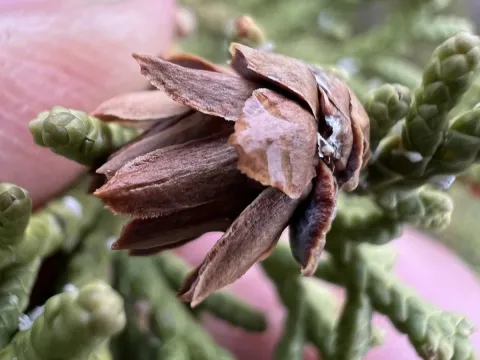
Utah juniper
Juniperus osteosperma
The Utah juniper (Juniperus osteosperma) belongs to the Cupressaceae family. It is a slow-growing evergreen tree or large shrub primarily native to the arid regions of the southwestern United States, where it has evolved to survive extreme aridity.
What the section contains
Utah juniper
This species requires full sun exposure to maintain its structural density and healthy foliage. It is highly adapted to extreme temperature fluctuations, ranging from intense heat to severe frosts, making it a robust candidate for xeriscaping and drought-prone agricultural regions.
Regarding soil preferences, the Utah juniper thrives in well-drained, alkaline or calcareous soils. It possesses an extensive root system capable of penetrating rocky ground to reach deep moisture, which is a critical feature of its botanical adaptation.
Agrotechnical management should focus on maintaining optimal soil aeration and preventing waterlogging. Irrigation should be kept to a minimum once the plant is established, as excessive moisture often leads to root collar rot and other pathological issues.
- Space plants at least 3-5 meters apart to allow for lateral growth.
- Provide minimal fertilizer, as this species is adapted to nutrient-poor substrates.
- Use coarse mulch to prevent direct contact between foliage and wet soil.
The most significant threats to Juniperus osteosperma are fungal pathogens, specifically rust diseases (Gymnosporangium species) which can disfigure the tree and reduce its vitality if left unmanaged.
Insect pests such as spider mites and scale insects can infest the dense foliage, especially during prolonged dry periods. These pests stress the plant by depriving it of nutrients, leading to yellowing and premature needle drop.
Management of these threats involves cultural practices such as pruning dead wood to increase airflow within the canopy. Improving circulation is essential to prevent the accumulation of moisture that facilitates fungal outbreaks.
Chemical control should be considered only when infestation levels exceed economic thresholds. Systemic insecticides can be effective, but their use should be minimized to protect local beneficial insect populations.
In conclusion, the health of the Utah juniper in a managed environment depends largely on imitating its natural habitat. By selecting the correct site and avoiding over-watering, growers can significantly reduce the pressure from common pests and diseases.