
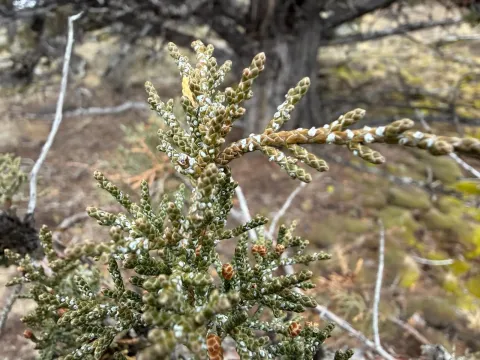
Western juniper
Juniperus occidentalis
Western juniper (Juniperus occidentalis) is a long-lived, evergreen conifer belonging to the Cupressaceae family. Native to the Pacific Northwest of the United States, it is well-adapted to harsh, high-elevation, and arid environments with rocky or volcanic soils.
What the section contains
Western juniper
The species demonstrates exceptional drought tolerance once established. It thrives in well-drained, nutrient-poor soil and is sensitive to poor drainage, making soil aeration a primary requirement for successful cultivation in horticultural settings.
As a light-demanding species, Western juniper requires full sun exposure to maintain its characteristic compact crown structure. It is highly resilient to cold temperatures, although it exhibits slow vertical growth patterns, often requiring several decades to reach maturity.
Botanically, it presents as a tree with a thick, fibrous bark and scale-like leaves that are arranged in whorls. Its seed cones are fleshy and dark blue, maturing into a hard, woody state that provides a distinctive visual profile throughout the seasons.
Its primary use is in landscape design and erosion control in arid climates. Due to its slow growth rate and rugged aesthetic, it is highly valued for xeriscaping projects and as a stable component of windbreaks in challenging environmental conditions.
Cedar-apple rust is the most prevalent fungal disease affecting the species. It forms noticeable galls on the branches, which produce spores that spread to rosaceous hosts, causing significant foliage damage and tree decline if left unmanaged.
Root rot, particularly caused by Phytophthora species, poses a severe risk in areas with excessive soil moisture. This condition leads to the destruction of the root system, causing the foliage to fade from green to bronze and eventual death of the specimen.
The juniper scale and spider mites are the most detrimental pests. These insects colonize the dense foliage, extracting sap and creating favorable conditions for secondary sooty mold growth, which inhibits photosynthesis and weakens the tree's immune system.
Effective management involves the implementation of strict cultural practices, such as ensuring proper spacing between plants to maximize airflow. Good sanitation, including the removal of dead or infected branches, is essential to minimize pathogen build-up.
Chemical control strategies should be applied selectively. Utilizing horticultural oils during the dormant season can effectively suppress overwintering insect populations, while systemic fungicides are recommended for active infection stages in nursery-grown specimens.