
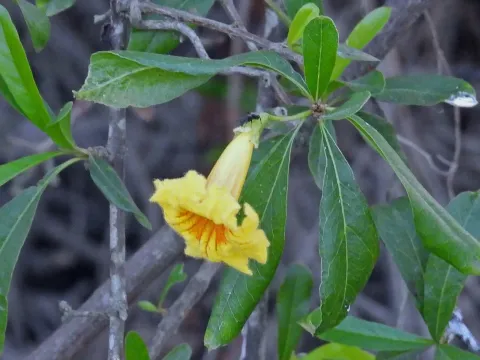
Tabebuia nodosa
Tabebuia nodosa
Tabebuia nodosa is a woody perennial species belonging to the Bignoniaceae family, native to the arid and semi-arid regions of South America.
What the section contains
Tabebuia nodosa
The plant is biologically optimized for tropical and subtropical climates, thriving in environments that experience distinct dry periods throughout the year.
Regarding soil requirements, it prefers well-drained, porous substrates that prevent water stagnation, ensuring root health in varied topographies.
High levels of solar radiation are essential for the plant to achieve its characteristic flowering, as it is a strictly light-demanding species.
Strategic planting should account for its slow growth rate, requiring minimal intervention once the root system is well-established in the field.
The primary economic value of Tabebuia nodosa lies in its dense, durable wood, which is utilized for specialized carpentry and heavy-duty structural applications.
Harvesting strategies are focused on sustainable forest management to ensure the preservation of wild populations while meeting demand for high-quality timber.
Beyond its timber value, the tree is widely recognized for its ornamental potential, enhancing public urban spaces and parks with its distinctive yellow floral displays.
Seed collection is performed after the mature fruit capsules dehisce, allowing for the systematic propagation of the species in controlled nursery settings.
Ongoing research explores the chemical properties of the plant, assessing potential applications for its extracts in medical and sustainable biochemical sectors.