
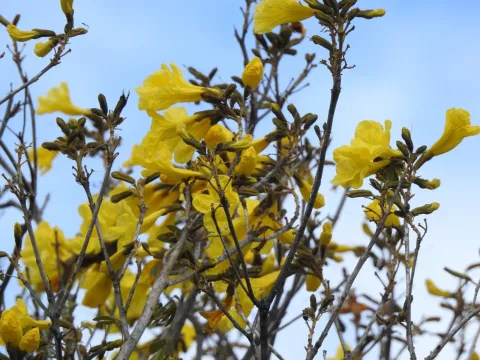
Handroanthus
Handroanthus
Handroanthus is a genus of flowering trees in the Bignoniaceae family, native to the tropical regions of the Americas. These trees are highly valued for their exceptionally dense and durable wood, often traded under the name "Ipe".
What the section contains
 Golden Trumpet Tree
Handroanthus chrysanthus
Golden Trumpet Tree
Handroanthus chrysanthus
 Guayacan
Handroanthus guayacan
Guayacan
Handroanthus guayacan
 Handroanthus capitatus
Handroanthus capitatus
Handroanthus capitatus
 Handroanthus chrysotrichus
Handroanthus chrysotrichus
Handroanthus chrysotrichus
 Handroanthus ochraceus
Handroanthus ochraceus
Handroanthus ochraceus
 Handroanthus umbellatus
Handroanthus umbellatus
Handroanthus umbellatus
 White trumpet tree
Handroanthus albus
White trumpet tree
Handroanthus albus
Handroanthus
The cultivation of these trees requires a tropical climate with high humidity and consistent temperatures. They thrive in locations that receive ample sunlight throughout the growing season.
Soil requirements focus on excellent drainage and fertility. Handroanthus species are intolerant to waterlogged soils, which can lead to rapid root decline and tree mortality in early stages.
Proper agronomic practices include regular irrigation for young saplings and protection from extreme wind exposure. These trees are slow-growing, necessitating a long-term strategy for plantation management.
Maintaining optimal spacing between trees is crucial to ensure adequate airflow and sunlight penetration. This reduces the competition for nutrients and supports the development of a healthy, strong trunk structure.
Fungal root pathogens represent the primary threat to the health of Handroanthus, particularly in plantations with improper drainage. Once established, these infections are difficult to eradicate.
Pests such as wood-boring beetles and defoliating caterpillars can significantly damage the growth cycle. Integrated pest management strategies are recommended to minimize the impact on wood quality.
Excessive moisture during the leaf development stage may lead to foliar diseases, causing premature leaf drop. Preventive measures include ensuring good ventilation within the canopy area.
Nutrient deficiency, specifically related to trace elements, can result in stunted growth and chlorosis. Balanced fertilization programs based on regular soil testing are essential for health maintenance.
Invasive weed species can outcompete young trees for light and water. Effective weed control in the early years of the plantation is vital for the tree's survival and growth velocity.
The primary commercial product of Handroanthus is its high-density timber, known as Ipe. It is widely used in high-end construction for decking, marine pilings, and heavy-duty structural components.
The bark, specifically from the inner layer, is harvested to produce "Lapacho" or "Pau d'arco," which is used globally in herbal medicine for its potential anti-inflammatory properties.
Due to the slow growth rate of these trees, sustainable harvesting practices are of utmost importance. Modern forestry management focuses on selective logging to protect natural populations.
After harvesting, the wood requires a precise drying process to prevent internal stress and cracking. This ensures the structural integrity required for high-performance applications.
The industry continues to invest in scientific research to improve the propagation and yield of these trees, aiming to balance economic needs with ecological sustainability.