
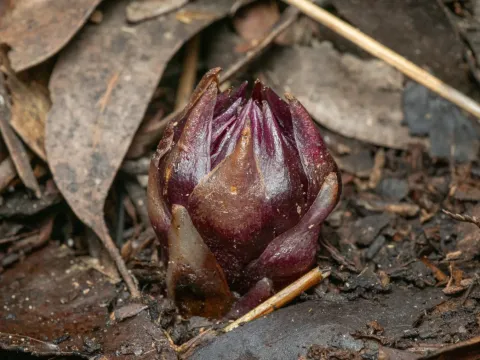
Rhizanthella
Rhizanthella
Rhizanthella is a genus of rare orchids endemic to Australia, known for being one of the few plants that complete their entire life cycle underground. Due to its extreme biological requirements, it is not considered an agricultural crop and has no history of cultivation.
What the section contains


Rhizanthella
Belonging to the Orchidaceae family, this plant is a total mycoheterotroph. It lacks chlorophyll and cannot perform photosynthesis. Instead, it obtains nutrients through a complex symbiotic relationship with fungi, which in turn are connected to the root systems of native Melaleuca shrubs.
The environmental requirements for Rhizanthella are highly specialized. It requires specific sandy soil conditions and a stable underground microenvironment. The presence of the specific host shrub and the associated fungal network is essential for its survival, which cannot be artificially replicated in a controlled agricultural setting.
There are no established agrotechnical practices for growing Rhizanthella. Attempts to cultivate it would likely result in failure as the plant is strictly dependent on undisturbed natural ecological interactions. It does not respond to traditional fertilizers, soil management, or nursery conditions.
This species has no commercial or agricultural use. It is strictly protected under conservation laws due to its rarity and scientific value. Research is focused exclusively on understanding its evolutionary history and the intricate symbiotic mechanisms that allow it to thrive beneath the forest floor.