
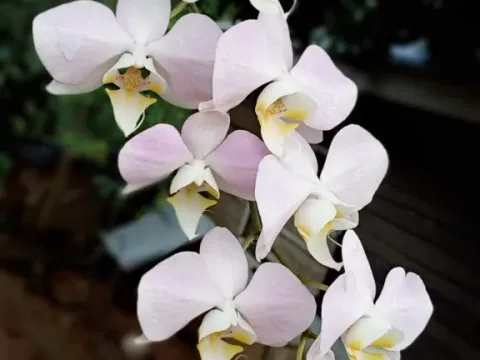
Phalaenopsis
Phalaenopsis
Phalaenopsis is a prominent genus within the Orchidaceae family, known for its epiphytic lifestyle. Originating from the tropical regions of Southeast Asia, these plants have adapted to high humidity and stable temperatures characteristic of rainforest environments.
What the section contains
 Phalaenopsis amboinensis
Phalaenopsis amboinensis
Phalaenopsis amboinensis
 Phalaenopsis aphrodite
Phalaenopsis aphrodite
Phalaenopsis aphrodite
 Phalaenopsis bellina
Phalaenopsis bellina
Phalaenopsis bellina
 Phalaenopsis cornu-cervi
Phalaenopsis cornu-cervi
Phalaenopsis cornu-cervi
 Phalaenopsis deliciosa
Phalaenopsis deliciosa
Phalaenopsis deliciosa
 Phalaenopsis fasciata
Phalaenopsis fasciata
Phalaenopsis fasciata
 Phalaenopsis floresensis
Phalaenopsis floresensis
Phalaenopsis floresensis
 Phalaenopsis gigantea
Phalaenopsis gigantea
Phalaenopsis gigantea
 Phalaenopsis hieroglyphica
Phalaenopsis hieroglyphica
Phalaenopsis hieroglyphica
 Phalaenopsis hybrid
s
Phalaenopsis hybrid
Phalaenopsis hybrids
 Phalaenopsis inscriptiosinensis
Phalaenopsis inscriptiosinensis
Phalaenopsis inscriptiosinensis
 Phalaenopsis javanica
Phalaenopsis javanica
Phalaenopsis javanica
 Phalaenopsis lowii
Phalaenopsis lowii
Phalaenopsis lowii
 Phalaenopsis lueddemanniana
Phalaenopsis lueddemanniana
Phalaenopsis lueddemanniana
 Phalaenopsis mannii
Phalaenopsis mannii
Phalaenopsis mannii
 Phalaenopsis parishii
Phalaenopsis parishii
Phalaenopsis parishii
 Phalaenopsis pulcherrima
Phalaenopsis pulcherrima
Phalaenopsis pulcherrima
 Phalaenopsis schilleriana
Phalaenopsis schilleriana
Phalaenopsis schilleriana
 Phalaenopsis subparishii
Phalaenopsis subparishii
Phalaenopsis subparishii
 Phalaenopsis taenialis
Phalaenopsis taenialis
Phalaenopsis taenialis
 Phalaenopsis tetraspis
Phalaenopsis tetraspis
Phalaenopsis tetraspis
 Phalaenopsis violacea
Phalaenopsis violacea
Phalaenopsis violacea
Phalaenopsis
Successful commercial cultivation requires precise control over lighting, favoring bright, filtered light. Exposure to intense, direct sunlight causes severe photo-inhibition and tissue damage, while insufficient light leads to spindly growth and lack of flowering.
The optimal substrate for these plants consists of coarse pine bark or specialized epiphytic mixes. Unlike terrestrial crops, Phalaenopsis roots require significant aeration, making organic matter that breaks down or packs tightly unsuitable for long-term production.
Irrigation practices must prioritize the health of the velamen-covered roots. Watering is performed until the substrate is thoroughly saturated, followed by a drying period that allows for oxygen exchange, which is critical to preventing anaerobic conditions.
Temperature management is a key tool in professional production, specifically for spike induction. Many commercial hybrids are subjected to a cooler night-time temperature regime (around 16°C) for several weeks to stimulate the initiation of inflorescences.
The primary threats to Phalaenopsis are bacterial and fungal diseases, often stemming from poor cultural practices such as water stagnation in the crown or excessive humidity. Bacterial soft rot, caused by Erwinia species, can destroy a healthy plant within days.
Pest management focuses on controlling sucking insects, with mealybugs and spider mites being the most common challenges. These pests weaken the host plant by depleting sap and can serve as vectors for secondary pathogens.
Thrips present a persistent challenge to inflorescence quality, as their feeding activity causes disfigurement of flowers and buds, significantly reducing the market value of the crop in floriculture.
Root rot, associated with improper substrate moisture, is the most common cause of crop loss. It is characterized by the breakdown of root tissues, leading to the collapse of the entire plant structure as water and nutrient uptake ceases.
Integrated pest management (IPM) strategies, including the use of systemic insecticides and strict sanitation protocols, are essential for maintaining the health of production greenhouses and preventing large-scale outbreaks.