
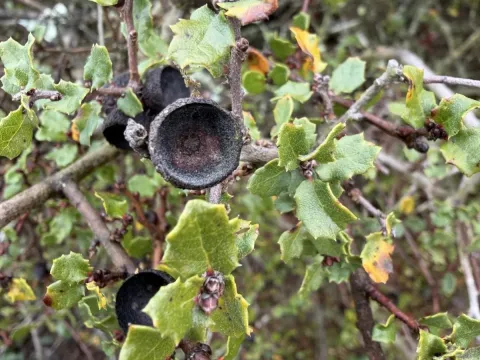
Oak
Quercus L.
The sowing of acorns is typically performed in the autumn immediately after harvest to facilitate natural stratification in the soil throughout the winter months.
What the section contains
 Algerian oak
Quercus canariensis Willd.
Algerian oak
Quercus canariensis Willd.
 Auzandri Oak
Quercus x auzandrii Gren. & Godr.
Auzandri-Morisii hybrid oak
Quercus x auzandrii Gren. & Godr. x Quercus x morisii Borzì
Bimundorum Oak
Quercus x bimundorum E. J. Palmer
Auzandri Oak
Quercus x auzandrii Gren. & Godr.
Auzandri-Morisii hybrid oak
Quercus x auzandrii Gren. & Godr. x Quercus x morisii Borzì
Bimundorum Oak
Quercus x bimundorum E. J. Palmer
 Brewer's oak
Quercus garryana Douglas ex Hook. var. breweri (Engelm.) Jeps.
Brewer's oak
Quercus garryana Douglas ex Hook. var. breweri (Engelm.) Jeps.
 Bruttian oak
Quercus robur L. subsp. brutia (Ten.) O. Schwarz
Bruttian oak
Quercus robur L. subsp. brutia (Ten.) O. Schwarz
 Bur oak
Quercus macrocarpa Michx.
Bur oak
Quercus macrocarpa Michx.
 Canyon live oak
Quercus chrysolepis Liebm.
Canyon live oak
Quercus chrysolepis Liebm.
 Caucasian English Oak
Quercus robur L. x Quercus macranthera Fisch. & C. A. Mey. ex Hohen.
Caucasian English Oak
Quercus robur L. x Quercus macranthera Fisch. & C. A. Mey. ex Hohen.
 Congested oak
Quercus congesta C. Presl
Congested oak
Quercus congesta C. Presl
 Cork oak
Quercus suber L.
Cork oak
Quercus suber L.
 Dalechamp's oak
Quercus dalechampii Ten.
Dalechamp's oak
Quercus dalechampii Ten.
 Downy oak
Quercus pubescens Willd.
English oak
Quercus robur L.
Downy oak
Quercus pubescens Willd.
English oak
Quercus robur L.
 Escarpment live oak
Quercus fusiformis Small
Garry oak
Quercus garryana Douglas ex Hook.
Escarpment live oak
Quercus fusiformis Small
Garry oak
Quercus garryana Douglas ex Hook.
 Gussone's Oak
Quercus gussonei (Borzì) Brullo
Gussone's Oak
Quercus gussonei (Borzì) Brullo
 Holly oak ballota
Quercus ilex L. subsp. ballota (Desf.) Samp.
Holm oak
Quercus ilex L.
Holm oak
Quercus ilex L. subsp. ilex
Holly oak ballota
Quercus ilex L. subsp. ballota (Desf.) Samp.
Holm oak
Quercus ilex L.
Holm oak
Quercus ilex L. subsp. ilex
 Hungarian oak
Quercus frainetto Ten.
Hungarian oak
Quercus frainetto Ten.
 Hybrid white and swamp chestnut oak
Quercus alba x Quercus michauxii x Quercus michauxii
Hybrid white and swamp chestnut oak
Quercus alba x Quercus michauxii x Quercus michauxii
 Iberian oak
Quercus petraea (Matt.) Liebl. subsp. iberica (Steven ex M. Bieb.) Krassiln.
Iberian oak
Quercus petraea (Matt.) Liebl. subsp. iberica (Steven ex M. Bieb.) Krassiln.
 Kellogg oak
Quercus kelloggii Newb.
Kellogg oak
Quercus kelloggii Newb.
 Kermes oak
Quercus coccifera L.
Lannes oak
Quercus x crenata Lam.
Kermes oak
Quercus coccifera L.
Lannes oak
Quercus x crenata Lam.
 McDaniel Oak
Quercus macdanielii
McDaniel Oak
Quercus robur x Quercus macrocarpa x Quercus macdanielii
McDaniel Oak
Quercus macdanielii
McDaniel Oak
Quercus robur x Quercus macrocarpa x Quercus macdanielii
 Mongolian oak
Quercus mongolica Fisch. ex Ledeb.
Moris Oak
Quercus x morisii Borzì
Mongolian oak
Quercus mongolica Fisch. ex Ledeb.
Moris Oak
Quercus x morisii Borzì
 Mount Tabor oak
Quercus ithaburensis Decne.
Mount Tabor oak
Quercus ithaburensis Decne.
 Northern red oak
Quercus rubra L.
Northern red oak
Quercus rubra L.
 Overcup oak
Quercus lyrata Walter
Pedunculate oak
Quercus robur L. subsp. pedunculiflora (K. Koch) Menitsky
Overcup oak
Quercus lyrata Walter
Pedunculate oak
Quercus robur L. subsp. pedunculiflora (K. Koch) Menitsky
 Persian oak
Quercus macranthera Fisch. & C. A. Mey. ex Hohen.
Persian oak
Quercus macranthera Fisch. & C. A. Mey. ex Hohen.
 Pin oak
Quercus palustris Münchh.
Pin oak
Quercus palustris Münchh.
 Portuguese oak
Quercus faginea Lam.
Portuguese oak
Quercus faginea Lam. subsp. faginea
Portuguese oak
Quercus faginea Lam.
Portuguese oak
Quercus faginea Lam. subsp. faginea
 Pyrenean oak
Quercus pyrenaica Willd.
Pyrenean oak
Quercus pyrenaica Willd.
 Quercus variabilis
 Blume
Quercus variabilis
Quercus variabilis Blume
 Sawtooth oak
Quercus acutissima Carruth.
Sawtooth oak
Quercus acutissima Carruth.
 Scarlet oak
Quercus coccinea Münchh.
Schoch oak
Quercus x schochiana Dieck
Sessile oak
Quercus petraea (Matt.) Liebl.
Scarlet oak
Quercus coccinea Münchh.
Schoch oak
Quercus x schochiana Dieck
Sessile oak
Quercus petraea (Matt.) Liebl.
 Shumard Oak
Quercus shumardii Buckley
Shumard Oak
Quercus shumardii Buckley
 Southern live oak
Quercus virginiana Mill.
Southern live oak
Quercus virginiana Mill.
 Swamp chestnut oak
Quercus michauxii Nutt.
Swamp chestnut oak
Quercus michauxii Nutt.
 Swamp white oak
Quercus bicolor Willd.
Swamp white oak
Quercus bicolor Willd.
 Trojan oak
Quercus trojana Webb
Trojan oak
Quercus trojana Webb
 Turkey oak
Quercus cerris L.
Turkey oak
Quercus cerris L.
 Upland willow oak
Quercus hemisphaerica W. Bartram ex Willd.
Valonia oak
Quercus ithaburensis Decne. subsp. macrolepis (Kotschy) Hedge & Yalt.
Upland willow oak
Quercus hemisphaerica W. Bartram ex Willd.
Valonia oak
Quercus ithaburensis Decne. subsp. macrolepis (Kotschy) Hedge & Yalt.
 White oak
Quercus alba L.
White oak
Quercus alba L.
 Willow oak
Quercus phellos L.
Willow oak
Quercus phellos L.
Oak
If spring sowing is required, acorns must be stored at temperatures ranging from 0 to +3 degrees Celsius under moist conditions to prevent desiccation of the embryo.
A planting depth of 5 to 8 centimeters is recommended to protect the seed from frost and to ensure adequate soil moisture for the emerging taproot.
When producing seedlings in nurseries, spacing must be carefully managed to allow for the development of a strong, deep root system essential for later survival.
Reforestation efforts often utilize either direct seeding or the outplanting of 1–2-year-old containerized seedlings to improve establishment rates in the field.
Oak belongs to the Fagaceae family and prefers deep, fertile, and well-drained loamy soils to achieve optimal growth and development.
As a light-demanding species, especially during its youth, oaks require proper canopy management to ensure sufficient sunlight for photosynthesis.
The species exhibits high cold tolerance, although it is susceptible to late spring frosts that can damage developing buds and young annual shoots.
The ideal range for cultivation includes temperate climates where annual precipitation is sufficient to avoid drought stress during the growing season.
Good soil drainage is critical, as waterlogged conditions often lead to root rot and diminished vigor in both young seedlings and mature stands.
The primary economic value of oak is its high-quality timber, which is highly prized for furniture, flooring, construction, and barrel production.
Productivity is measured by the volume of stem wood produced over a rotation period that typically spans 80 to 120 years before final harvest.
Acorn production is cyclical, highly dependent on weather conditions and tree age, and serves as a vital resource for forest biodiversity and wildlife.
The bark of the oak tree contains significant levels of tannins, which are utilized in the leather processing and pharmaceutical industries.
Sustainable management practices are required to ensure a consistent annual increment of timber while maintaining the long-term health of the ecosystem.
The oak leaf roller (Tortrix viridana) is a major defoliator that can cause severe damage to leaf cover, leading to reduced growth and weakened tree health.
Powdery mildew represents a common fungal threat, particularly in nursery settings, where it can impede the development of young seedlings.
Wood-boring insects, including various species of Buprestidae, often attack trees weakened by environmental stressors, posing a risk of mass mortality.
Vascular wilts and bark necrosis are significant diseases that disrupt the tree's internal transport system, often resulting in crown dieback.
Effective management strategies involve regular health assessments, pheromone monitoring, and the removal of infected or susceptible host trees.