
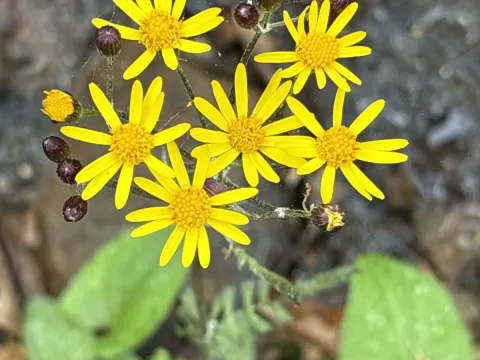
Golden ragwort
Packera aurea
Golden ragwort (Packera aurea), formerly known as Senecio aureus, is a perennial herbaceous plant belonging to the Asteraceae family. It typically develops a basal rosette of leaves and a fibrous root system.
What the section contains
Golden ragwort
During the blooming season, it produces an erect flowering stalk reaching heights of 60 to 80 cm. The basal leaves are characteristically rounded or heart-shaped, while the stem leaves are pinnately lobed.
The plant features bright, golden-yellow daisy-like flower heads arranged in a loose corymb at the top of the stems. It is known for its strong ability to regenerate from root fragments.
As a perennial weed, it spreads both via wind-dispersed seeds and vegetatively through its rhizomes, which can be easily broken and spread during soil cultivation practices.
It is an early-season grower, which allows it to establish itself ahead of many summer crops, thereby securing space and resources for its own development within the field.
Golden ragwort thrives in moist to wet, partially shaded environments. In agricultural settings, it is commonly found in low-lying areas, near drainage ditches, and along forest edges.
It is highly adapted to damp meadows, wetlands, and riparian zones, often encroaching into agricultural lands that exhibit poor drainage or high soil moisture levels.
The weed is frequently observed in pastures, forage crop fields, and occasionally in grain fields that are situated on poorly drained or alluvial types of soil.
Spread across a field often initiates from undisturbed buffer zones, fence lines, or peripheral ditches, where the plant can establish a stable colony before expanding.
Its ecological preference for water-saturated soils makes it a significant issue in years with high rainfall, where standard cultivation may not be sufficient to suppress it.
The primary harm caused by Golden ragwort is its aggressive competition for essential soil nutrients and water, which stunts the growth of surrounding crops.
The dense leaf rosettes create significant shade, which inhibits the initial development of young crop plants, reduces their photosynthetic capacity, and ultimately lowers the harvest yield.
It poses a direct health threat to livestock because the plant contains pyrrolizidine alkaloids, which are toxic if ingested by cattle or horses grazing in infested fields.
Furthermore, it can act as a secondary host for various crop pathogens and insects, facilitating the spread of diseases within the agricultural ecosystem.
During harvest, heavy infestations can interfere with the operation of harvesting machinery, as the sturdy stalks and extensive roots can clog mechanical equipment.
Agrotechnical control measures focus on improving soil drainage and intensive tillage. Deep plowing helps to disturb and dessicate the root system, hindering further regrowth.
Crop rotation remains a highly effective strategy, specifically alternating with competitive crops that provide early canopy closure, depriving the weed of necessary sunlight.
Mechanical management, such as timely mowing before seed set, prevents the spread of the weed to non-infested areas of the farm, though it does not remove existing roots.
Chemical control involving systemic herbicides applied during the active growth phase is often required for effective eradication of the perennial root structure.
- Deep plowing to exhaust rhizomes.
- Improved field drainage systems.
- Mowing before seed production.
- Selective herbicide application.