
Grindelia nana
Grindelia nana
Description
How to tell it apart
Grindelia nana, commonly known as low gumweed, belongs to the Asteraceae family. It is a perennial herb characterized by a tough taproot system that enables survival in arid environments.
The plant typically grows as a low-lying or moderately tall shrub with numerous branched stems that can be smooth or possess sparse hair.
Its leaves are lanceolate to oblong in shape with finely serrated margins. A defining feature is the secretion of a sticky resin that covers the flower heads.
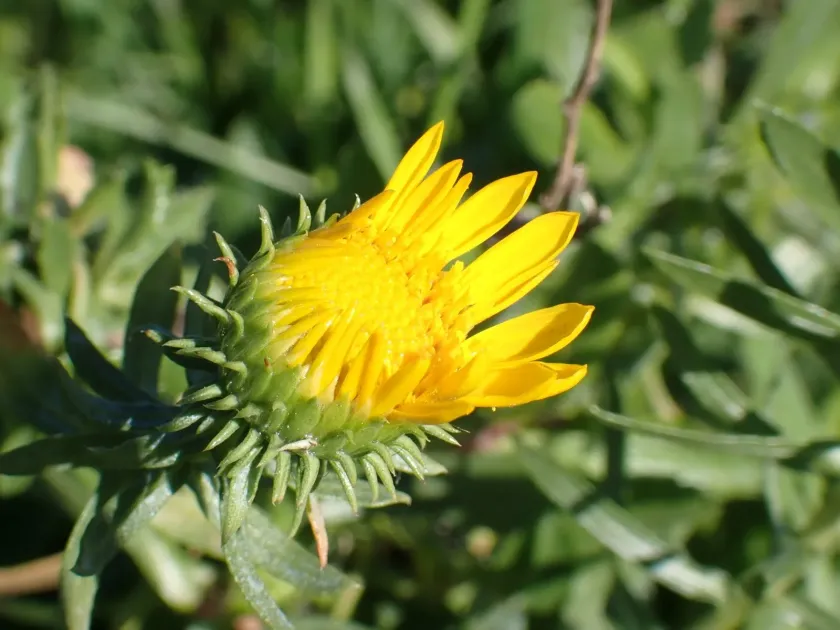
The flower heads contain both yellow ray and disc florets. The involucre consists of multiple phyllaries that are often bent back and coated in a viscous, sticky exudate.
The seeds are equipped with a pappus, a specialized structure that allows for effective wind dispersal across large areas, making the weed difficult to contain.
Where it grows
This species is native to western North America, primarily inhabiting open, arid regions, grasslands, and prairies with limited soil resources.
It frequently colonizes roadsides, waste areas, and disturbed landscapes where competition from denser vegetation is virtually non-existent.
In agricultural settings, Grindelia nana often invades cereal crops and forage fields, particularly in regions where drought stress is a significant factor.
The plant exhibits high ecological plasticity, allowing it to thrive in various soil types, ranging from sandy loam to rocky, nutrient-poor substrates.
Due to its resilience, the weed quickly establishes itself in fallow lands, representing a persistent challenge for land reclamation and future cultivation.
Harm it causes
The primary damage caused by this weed is intense competition for soil moisture and nutrients, which significantly limits the growth of crops in arid climates.
Its extensive root system acts as a resource sink, depleting water reserves in the soil profile and reducing overall crop yields and biomass production.
The sticky resin produced by the plant can clog harvesting machinery, causing downtime and increasing maintenance costs during the harvest season.
Grindelia nana can act as an alternative host for various pests and diseases that potentially migrate to economic crops, complicating integrated pest management.
In pasture systems, the presence of low gumweed reduces the available grazing area by crowding out desirable forage grasses, leading to lower livestock productivity.
How to control
Effective management begins with deep tillage, which is essential to sever the taproot and inhibit the regenerative potential of this perennial weed.
Implementing a rigorous crop rotation schedule that includes high-density cover crops helps to shade out the weed and minimize its establishment success.
Timely mowing or mechanical removal prior to the flowering stage is critical to prevent seed production and reduce the overall seed bank in the soil.
Chemical control options include the use of systemic herbicides; however, applications are most effective when timed during the rosette stage of plant development.
Integrated weed management, combining mechanical tillage with targeted herbicide application, remains the most viable approach for long-term control of this plant.
Taxonomy
- Latin name
- Grindelia nana
- Family
- Сложноцветные (астровые)
- EPPO code
- GRNNA