
Giant ragweed
Ambrosia trifida
Description
How to tell it apart
Giant ragweed (Ambrosia trifida) is a robust annual weed belonging to the Asteraceae family. It is recognized as one of the most competitive and aggressive weeds in agricultural systems across North America and other regions.
The plant features a stout, erect stem that can reach heights of 3 to 4 meters under ideal conditions. It is typically branched and covered in coarse, stiff hairs, which gives it a rough texture.
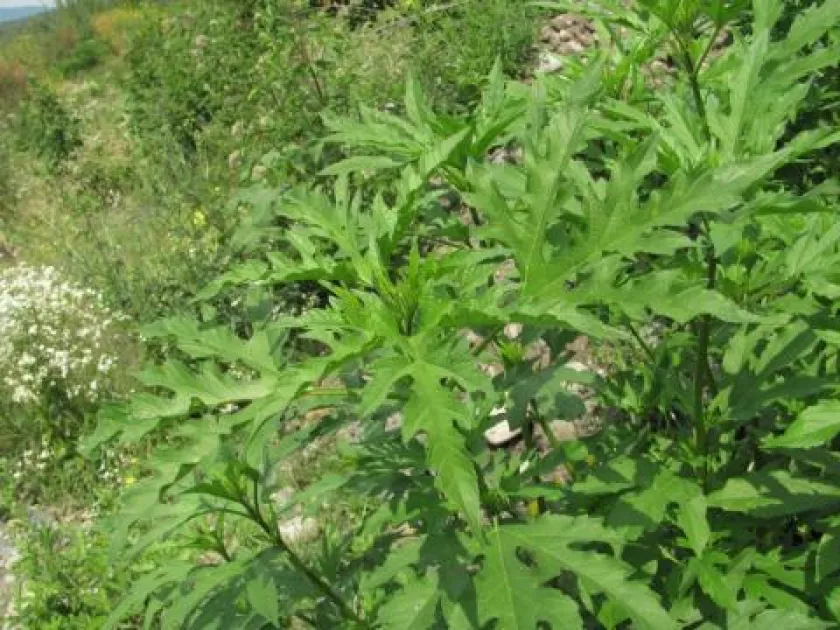
The leaves are characteristically opposite and deeply palmately lobed, usually with three major lobes, though larger lower leaves may have five or more. This leaf structure allows for high photosynthetic rates and rapid growth.
Flower heads are arranged in long, terminal spikes. The plant is monoecious, producing significant quantities of wind-borne pollen, which is a major contributor to seasonal hay fever and respiratory allergies.
Its taproot system is deep and well-developed, enabling the plant to access moisture and nutrients from soil profiles that shorter crops cannot reach, thereby maintaining growth even during dry spells.
Where it grows
Giant ragweed thrives in fertile, moist soils and is commonly found in riparian areas, along roadsides, and in disturbed agricultural environments. It is highly adaptable to various nitrogen-rich sites.
In farming, it is a significant pest in corn, soybean, and small grain production. It frequently emerges early in the spring, allowing it to gain a head start over many row crops.
The weed spreads primarily through seed dispersal, which can occur via water runoff, farm machinery, and birds. Its persistence in the seed bank makes it a long-term management challenge for farmers.
It prefers high-light environments and does not tolerate long-term shade, which is why it exploits gaps in crop canopies. It is particularly prevalent in fields where crop rotation is limited.
Global distribution of this weed has increased due to its ability to colonize fields quickly and its tolerance to common tillage practices if the soil is not inverted correctly.
Harm it causes
The primary harm caused by giant ragweed is extreme resource competition. It rapidly depletes soil moisture and nitrogen, which significantly reduces the yield potential of the primary crop.
Because of its immense height, it casts dense shadows over crops like soybeans or corn, drastically reducing the amount of sunlight reaching the lower leaves and hindering plant development.
It acts as a host for various insects and plant diseases. By harboring these pests, the weed increases the pressure on cultivated crops and requires additional management inputs throughout the year.
Harvest interference is a common economic loss, as the thick, woody stems can damage harvesting equipment and increase the moisture content of the grain, necessitating costly post-harvest drying.
The allergenic nature of the pollen poses health risks to workers, potentially limiting manual labor availability or efficiency during peak periods like the end of the summer season.
How to control
Effective management requires an integrated approach. Cultural practices, such as choosing competitive crop hybrids and optimal planting densities, help the crop canopy close faster and shade out emerging weeds.
Mechanical control, such as pre-plant tillage or timely row cultivation, is crucial for eliminating early-flushing weeds before they become resistant to chemical treatment or too large to manage.
Chemical control relies on the timely application of herbicides. Since resistance to glyphosate and ALS-inhibitors has been documented, farmers must use multi-mode-of-action herbicide programs.
Pre-emergence herbicides are vital for preventing the initial flush, while post-emergence treatments should be applied when the ragweed is small (less than 10-15 cm tall) to ensure maximum efficacy.
- Use of multi-mode-of-action herbicides.
- Integrated weed management (IWM) strategies.
- Strategic crop rotation to break life cycles.
- Equipment sanitation to prevent seed movement.
- Monitoring fields for early detection of escapes.
Taxonomy
- Latin name
- Ambrosia trifida
- Family
- Сложноцветные (астровые)
- EPPO code
- AMBTR