
Flaveria australasica
Flaveria australasica
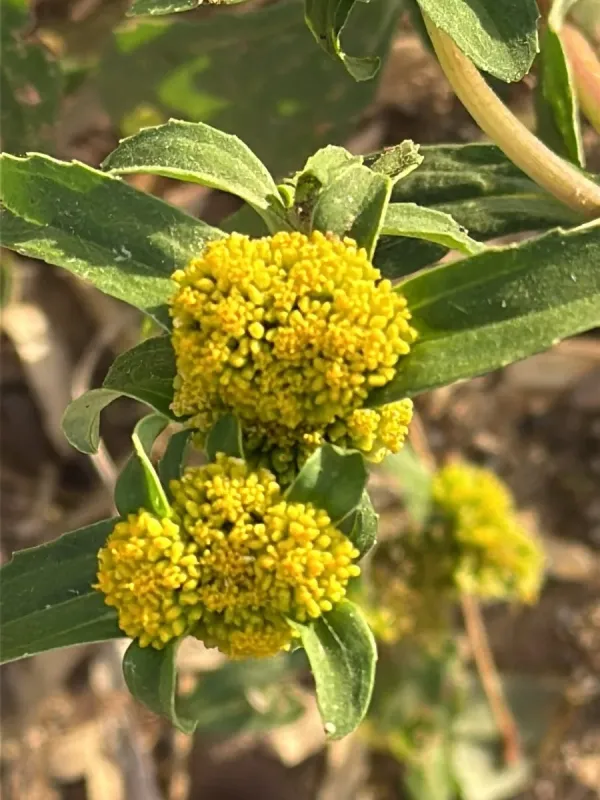
Description
How to tell it apart
Flaveria australasica, commonly known as Australian yellowweed, belongs to the Asteraceae family. It is an annual herbaceous plant that can grow up to 80 centimeters tall, often distinguished by its erect stems that may show a reddish hue near the base.
The leaves are arranged oppositely along the stem and typically have a lanceolate or linear shape. The leaf surface is generally smooth, though fine pubescence may be present in some environmental conditions, which helps in moisture retention.
The inflorescences consist of small, dense flower heads grouped into corymbs at the tips of the branches. The flowers are yellow and bloom in clusters, providing a characteristic appearance when the plant reaches its reproductive stage.
The fruit is a small achene, often equipped with a pappus, allowing for efficient wind dispersal across large distances. This prolific seed production is a key factor in the weed's ability to colonize new areas rapidly.
As a C4 photosynthetic plant, Flaveria australasica exhibits high growth efficiency under high light and temperature conditions. This adaptation allows it to thrive in arid climates while outperforming many traditional crops.
Where it grows
The primary habitat of Flaveria australasica is the arid and semi-arid regions of Australia. It is frequently found in open areas with disturbed soil, such as roadsides, grazing lands, and dry riverbeds.
The weed is highly adaptable and often thrives in saline soils where other vegetation struggles to establish. Its synanthropic nature means it readily exploits areas impacted by human activity, including agricultural fields and drainage ditches.
In farming systems, it is a common invader of irrigated crops. The availability of water in these environments, combined with high temperatures, allows the weed to grow vigorously and form dense, competitive stands.
Flaveria australasica is highly tolerant to drought conditions, remaining dormant or growing slowly during dry spells before recovering rapidly after rain. This persistence makes it a persistent challenge for farmers in desert-edge climates.
The longevity of its seeds in the soil seed bank ensures that the weed can persist in a field even after several years of management, ready to germinate when conditions are ideal for growth.
Harm it causes
The primary damage caused by Flaveria australasica is intense competition for soil moisture and nutrients. Because of its C4 metabolism, the weed can sequester resources faster than many crop species, leading to stunted crop development.
When present in large numbers, the weed shades out crop seedlings, inhibiting their photosynthetic potential. This competition results in uneven stand establishment and significantly reduced yields at harvest time.
The plant can serve as an alternative host for various crop pests and pathogens. This increases the risk of disease transmission into the crop fields, complicating pest management programs and increasing the need for pesticides.
The physical presence of the weed in the field interferes with mechanized agricultural practices. Large infestations can clog harvesting equipment, reducing operational efficiency and increasing the maintenance costs for machinery.
Seed contamination is another economic threat, as the presence of weed seeds in the harvest requires additional processing steps and may lead to price docking or rejection of the grain lot by buyers.
How to control
Effective management begins with integrated cultural practices, such as crop rotation. Choosing competitive crop varieties that cover the soil quickly can help suppress the weed by restricting light availability.
Deep tillage can be an effective mechanical control method, burying the seeds deep enough to prevent successful germination. Regular cultivation of fallow fields is also essential to break the weed's life cycle before it produces seeds.
Chemical control involves the use of selective herbicides applied at the early vegetative stage of the weed. Precise timing is critical, as larger plants become significantly more tolerant to common herbicide treatments.
Managing the surrounding area is vital; eliminating weed populations along roads and fence lines prevents the influx of new seeds into the field. Ensuring that seed lots are clean before planting is also a fundamental preventive measure.
- Monitor fields frequently for early detection of infestations.
- Rotate herbicide modes of action to prevent the development of weed resistance.
- Implement precise irrigation scheduling to minimize water availability in crop inter-rows.
- Maintain healthy crop density to enhance the competitive suppression of the weed.
Taxonomy
- Latin name
- Flaveria australasica
- Family
- Сложноцветные (астровые)
- EPPO code
- FLAAU