
Fitch's spikeweed
Centromadia fitchii
Description
How to tell it apart
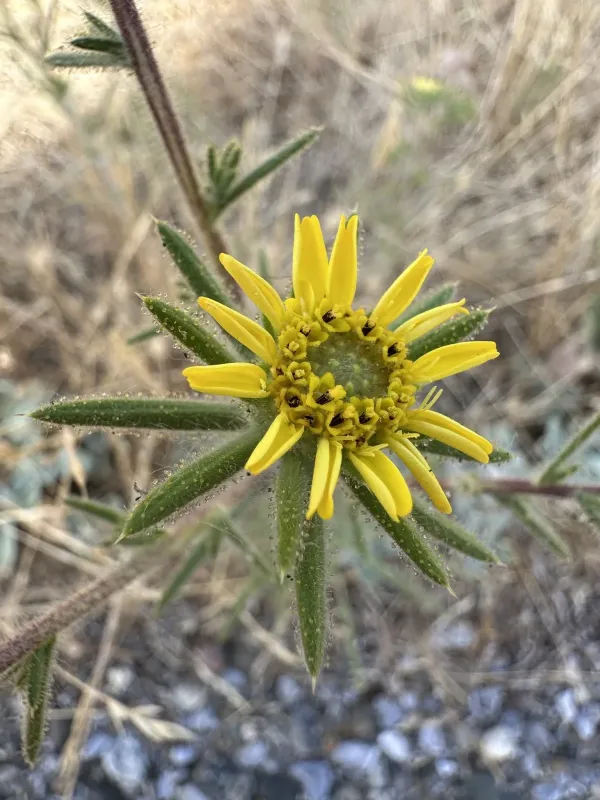
Fitch's spikeweed (Centromadia fitchii) belongs to the Asteraceae family. It is an annual herbaceous plant often confused with other species of the sunflower family due to its characteristic inflorescence appearance.
The plant has an erect stem that can branch in the upper part, reaching significant height. Leaves are narrow, often linear, alternate, and can feature spiny segments.
The main distinguishing feature is the yellow flowers gathered in small heads, surrounded by sharp bracts. These bracts make the plant very prickly to the touch during the flowering and fruiting phase.
The root system is of the taproot type, capable of reaching great depth, which provides the plant with high resistance to arid conditions and allows it to extract moisture from deep soil layers.
The fruits are small achenes that are easily dispersed by wind, water, and agricultural machinery, ensuring rapid colonization of new territories.
Where it grows
This weed is a typical representative of the flora of western North America, especially common in California. It prefers open, sunny areas with clay or rocky soils.
It is often found on abandoned fields, along roadsides, in railway rights-of-way, and in pastures. The plant possesses high ecological plasticity.
In agricultural production, it damages grain and row crop fields, especially under moisture-stressed conditions, where the weed acts as an aggressive competitor.
It actively occupies uncultivated lands, turning them into impassable thickets that serve as a reservoir for the weed's seed bank, threatening adjacent fields.
The spread of the species is closely linked to anthropogenic factors, including contaminated seed material and the movement of equipment between infested and clean field areas.
Harm it causes
The primary damage lies in intense competition with crops for water and mineral nutrients, which critically reduces yield during dry years.
The presence of spiny bracts makes mechanized harvesting extremely difficult and reduces the forage value of hay in pastures due to the injury of livestock.
The weed is capable of significantly depleting soil moisture, which negatively affects the development of subsequent crops in the rotation and reduces fertilizer efficiency.
Mass reproduction of the species leads to lower quality of commercial grain due to the presence of weed seeds, requiring additional costs for cleaning and grading products.
The biological nature of the species allows it to dominate on degraded lands, displacing valuable forage grasses and reducing the biodiversity of the agroecosystem.
How to control
Agrotechnical control methods include timely plowing and deep soil tillage, which effectively destroys young seedlings before they reach the flowering phase.
A crucial practice is maintaining crop rotation, incorporating crops with high plant density that can suppress weed development in the early growing season.
Application of systemic herbicides is effective at early development stages. The use of glyphosate-based products for pre-sowing field treatment is highly recommended.
- Mowing before seed production to prevent the replenishment of the soil seed bank.
- Usage of high-quality seed material, certified free from spikeweed contaminants.
- Regular monitoring and mechanical removal of individual specimens in the fields.
A comprehensive approach, combining chemical protection with agrotechnical measures, allows keeping the Fitch's spikeweed population at an economically safe level.
Taxonomy
- Latin name
- Centromadia fitchii
- Family
- Сложноцветные (астровые)
- EPPO code
- HEZFI