
Greater knapweed
Centaurea scabiosa
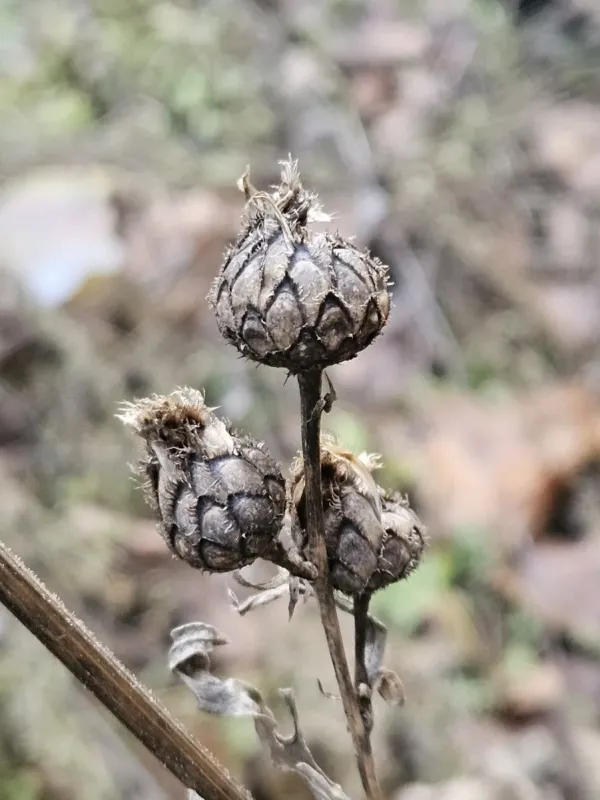
Description
How to tell it apart
Greater knapweed (Centaurea scabiosa) is a perennial herbaceous plant belonging to the Asteraceae family. It is characterized by an erect, branched stem that can reach heights of up to 120 centimeters.
The leaves are deeply pinnately lobed, which gives the plant a distinct, fern-like appearance. It possesses a strong taproot, allowing the plant to reach deep into the soil for water and nutrients.
The flower heads are large, purplish-pink in color, and feature enlarged marginal florets, which distinguish it from other knapweed species. It blooms from early summer through late autumn.
The seeds are equipped with a pappus, enabling efficient dispersal by wind across large areas, which makes it a persistent weed in agricultural and wild settings.
In its first year of growth, the plant typically remains as a basal rosette of leaves. This stage is crucial for early detection and intervention before the plant establishes its extensive root system.
Where it grows
This weed thrives in sunny, well-drained environments. It is commonly found in meadows, pastures, along roadsides, and on abandoned agricultural lands or fallows.
In cropping systems, Greater knapweed is problematic in cereal fields and established grasslands. It is highly adaptable to various soil types, particularly those with a calcareous base.
It occupies open gaps in the canopy, making it highly competitive in fields where the crop stand is thin or unevenly established due to environmental stresses.
The species is resilient to dry conditions, which allows it to persist in fields even during drought years when crop growth is otherwise restricted.
Spreading is primarily achieved via seeds, though once established, the plant's ability to sprout from root fragments during tillage makes it difficult to eradicate completely.
Harm it causes
The primary harm caused by Greater knapweed is through direct competition for resources, such as sunlight, water, and essential soil minerals, with the primary crop.
By shading out smaller crop seedlings and competing for limited soil moisture, it can significantly decrease biomass production and overall harvest yield.
Its presence at harvest time causes operational difficulties, as the tall, fibrous stems clog harvesting machinery and increase the moisture content of the harvested grain.
The weed also acts as a reservoir for various pests and fungal diseases, facilitating their spread to neighboring crop plants during the active growing season.
In pastures, while it may be grazed to some extent, it often dominates over more desirable forage species, thereby reducing the nutritional value and productivity of the grazing land.
How to control
Successful management of Greater knapweed requires a multi-year commitment, utilizing both mechanical suppression and chemical control agents where necessary.
Deep plowing is an essential mechanical measure to disrupt the taproot and minimize the potential for vegetative regrowth after the field has been cleared of the primary crop.
Chemical control involving selective herbicides is most effective when applied during the rosette stage, as the plant's metabolic activity is high and the root system is not yet fully mature.
In grain crops, the application of systemic herbicides such as 2,4-D or dicamba, applied at the correct growth stage, can effectively suppress knapweed populations.
- Regular crop rotation to disturb growth cycles.
- Intensive fallow cultivation to starve the root system.
- Application of systemic herbicides.
- Maintaining high crop density to shade out weeds.
Taxonomy
- Latin name
- Centaurea scabiosa
- Family
- Сложноцветные (астровые)
- EPPO code
- CENSC