
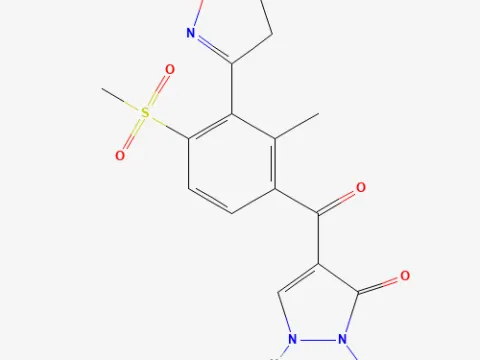
Topramezone
Topramezone belongs to the triketone chemical class. It is a systemic herbicide that acts as a highly selective inhibitor of the 4-hydroxyphenylpyruvate dioxygenase (4-HPPD) enzyme in weed plants.
What the section contains
Topramezone
Blocking this enzyme leads to a disruption in the synthesis of carotenoids. As a result, chlorophyll is degraded, which causes characteristic bleaching (chlorosis) of the weed tissues.
Upon application, the active ingredient is rapidly absorbed by leaves and roots. Due to its systemic properties, it translocates through the xylem and phloem, ensuring the death of even hard-to-control weed species.
Complete mortality of sensitive species occurs 2–3 weeks after application. Initially, discoloration of growth points takes place, followed by necrosis, which gradually covers the entire plant.
The high selectivity of topramezone towards corn is due to the rapid metabolism of the substance within the crop, making it safe for maize fields when regulations are followed.
Topramezone is highly effective against a wide spectrum of annual and perennial broadleaf weeds, as well as certain grass weed species.
The most sensitive species include: pigweed, common lambsquarters, common ragweed, knotweed species, black nightshade, datura, and velvetleaf.
The herbicide demonstrates excellent results in suppressing common milkweed and various spurge species, which are traditionally considered difficult to eradicate in corn crops.
The product works effectively against weed species that have developed resistance to other herbicide classes, such as sulfonylureas or triazines.
- Amaranthus retroflexus
- Chenopodium album
- Ambrosia artemisiifolia
- Abutilon theophrasti
- Solanum nigrum
The optimal time for applying topramezone is during the active growth phase of weeds. For broadleaf weeds, this is the 2–4 leaf stage, and for grasses, the 1–3 leaf stage.
Corn is typically at the 2 to 8 leaf stage, which provides sufficient leaf surface area for the absorption of the product.
Application rates depend on the weed species composition and the level of field infestation. Usually, the product is used in combination with adjuvants that improve adhesion and penetration.
To enhance the effect, tank mixtures with other herbicides are often used, which allows for expanding the spectrum of controlled species and preventing the development of resistant populations.
It is important to consider weather conditions: treatment is best carried out at temperatures between +15 and +25 degrees Celsius, avoiding severe drought or waterlogging.
It is not recommended to apply topramezone if the crop is under stress due to frost, pests, or moisture deficit.
There are crop rotation restrictions: in the year following topramezone application, most agricultural crops can be sown, but regional regulations should always be checked.
Treatment is prohibited if organophosphate insecticides are present in the tank mixture, as this may cause phytotoxicity to corn.
Avoid spray drift onto neighboring fields with sensitive crops, such as sugar beets, legumes, or sunflowers.
When working with the product, the use of personal protective equipment for skin, respiratory organs, and eyes is mandatory in accordance with the manufacturer's instructions.