
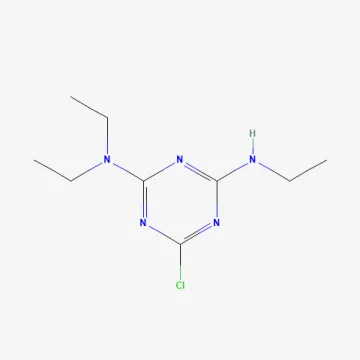
Trietazine
Description
Mode of action
Triazines represent a significant group of heterocyclic chemical compounds widely utilized in agriculture as selective herbicides. Their molecular structure is characterized by a six-membered ring containing three nitrogen atoms.
The primary mechanism of action involves the inhibition of photosynthesis in target plants. The active ingredients interfere with electron transport in photosystem II, effectively halting the synthesis of essential carbohydrates.
These herbicides are primarily absorbed by the root systems of plants from the soil solution. Once taken up, the active substances are translocated through the xylem to the active growth zones of the weeds.
In susceptible weed species, metabolic processes are disrupted shortly after the herbicide's uptake. This leads to progressive chlorosis of the tissues, ultimately resulting in the necrosis and death of the entire plant.
Tolerant crop species possess specific enzymatic pathways that rapidly detoxify the herbicide by converting it into non-toxic compounds. This biological mechanism allows for the safe and selective use of triazines in major crops.
What it targets
Triazines are effective against a broad spectrum of annual broad-leaved and some grassy weeds. Common targets include pigweed, lamb's quarters, knotweed, and chickweed, which are major threats to crop productivity.
These herbicides are commonly used in crops such as maize, potatoes, sunflowers, soybeans, and carrots. The specific choice of herbicide depends on the crop variety, soil profile, and regional weed resistance patterns.
Application is often performed as a pre-emergence treatment to create a protective barrier in the upper soil layer. This strategy targets germinating weed seeds before they can establish competition with the crop.
The effectiveness of triazines is strongly influenced by soil moisture and temperature conditions. Adequate soil moisture is crucial for the uptake of the active substance by the root systems of the target weeds.
Due to their soil activity, these herbicides remain effective for extended periods. This provides a long-lasting protective window, preventing secondary flushes of weeds in the early stages of crop development.
Rates and timing
Application timing ranges from pre-planting to early post-emergence stages. Agronomists must adhere to label specifications regarding the specific timing for each crop to ensure maximum efficacy and crop safety.
Dosage rates are strictly dependent on soil texture and organic matter content. For sandy soils with low humus levels, lower rates are required to prevent potential phytotoxicity to the crop.
On heavier clay or loamy soils, higher application rates are often necessary as soil particles can bind some of the active ingredient, reducing its immediate bioavailability in the soil solution.
For post-emergence application, timing is critical; treatments should be performed when weeds are in their seedling stage. Effectiveness decreases significantly as weeds mature and develop more robust defense mechanisms.
Uniform distribution during application is essential for optimal results. Farmers should ensure proper equipment calibration and avoid application during high winds to prevent drift onto non-target areas.
Restrictions
A primary concern with triazines is their persistence in the soil, which can influence future crop rotation plans. Residual activity may last for several months, requiring careful selection of subsequent crops.
Sensitive crops, such as sugar beets or specific legumes, may be at risk if planted too soon after a triazine-treated crop. Always refer to crop rotation intervals provided by the manufacturer.
Operators must wear appropriate personal protective equipment, including respirators, gloves, and eye protection, to minimize exposure during mixing and application. Ensure that standard handling procedures are followed.
Environmental protection is paramount; prevent herbicide runoff into nearby water bodies, as some triazine compounds can be harmful to aquatic ecosystems. Avoid cleaning spray equipment near wells or streams.
Storage should be restricted to secure, temperature-controlled facilities. Keeping containers labeled and in good condition is essential to prevent accidental contamination and ensure product efficacy over time.
Status in the European Union
Not approved in the EU
- CAS number
- 1912-26-1
- Category (EU)
- HB - Herbicide
EU status is for reference only and does not replace national registration in your country.