
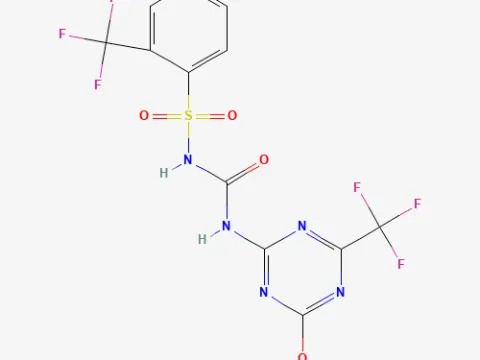
Tritosulfuron
Tritosulfuron belongs to the chemical class of sulfonylureas. It is a highly effective herbicidal active ingredient that blocks the enzyme acetolactate synthase (ALS) in susceptible plants.
What the section contains
Tritosulfuron
Inhibition of this enzyme leads to an immediate cessation of the biosynthesis of essential branched-chain amino acids: valine, leucine, and isoleucine.
As a result of the protein synthesis block, cell division in the meristematic tissues of weeds stops within a few hours after the product is absorbed.
The product moves systemically throughout the plant via both xylem and phloem flow, ensuring complete damage to the aerial parts and root system of susceptible species.
Visible symptoms of injury, such as chlorosis and necrosis of growing points, appear within a week, while total weed death occurs in 14–21 days.
Tritosulfuron is primarily used to control a broad spectrum of annual and some perennial broad-leaved weeds in cereal crop fields.
It is effective against such problematic species as catchweed bedstraw (cleavers), common lambsquarters, knotweeds, hemp-nettle, and other broad-leaved weeds.
The substance exhibits high biological activity even at low application rates, making it a convenient component for tank mixtures.
It is actively used against weeds that are resistant to other groups of herbicides, for example, growth regulator (hormone-like) agents.
It is especially valued for the ability to control species at early growth stages, which helps reduce competitive pressure on the crop during critical periods.
Tritosulfuron application rates vary depending on the species composition of weeds, their growth stages, and the climatic conditions of the region.
It is recommended to apply the product during the period of active weed growth, which generally corresponds to the two- to four-true-leaf stage for most species.
To increase effectiveness, it is often used in combination with stickers or surfactants that improve leaf wetting properties.
Application is possible over a wide time range: from the crop tillering phase to stem elongation, depending on the regulations of the specific product.
It is essential to monitor the quality of the spray solution application, ensuring uniform coverage of the weed leaf surface.
The main limitation is the risk of resistance development in weeds when using sulfonylurea herbicides repeatedly.
Treatment is not recommended if the crop is under stress due to drought, frost, or pest damage.
Tritosulfuron has certain crop rotation restrictions, so it is necessary to check the degradation period of the active substance in the soil before planting sensitive crops.
Drift of the spray solution to adjacent fields with sensitive broad-leaved crops is unacceptable due to the high herbicidal activity of the substance.
When handling the product, it is mandatory to strictly observe personal protection measures that prevent the concentrate from coming into contact with the skin and mucous membranes.