
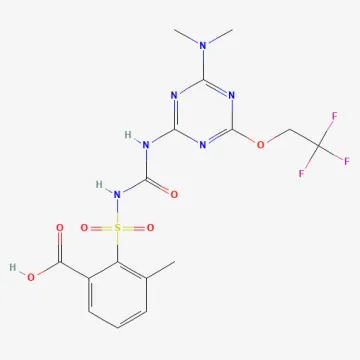
Triflusulfuron
Description
Mode of action
Triflusulfuron belongs to the sulfonylurea chemical class, widely used as a selective herbicide in agricultural practices for specific crop protection.
The mode of action involves inhibiting the acetolactate synthase (ALS) enzyme, which is essential for the biosynthesis of branched-chain amino acids in weeds.
By blocking the synthesis of valine, leucine, and isoleucine, the herbicide stops cell division and plant growth shortly after application, preventing weed competition.
The compound is absorbed primarily through the leaves and is rapidly translocated via the xylem and phloem to the meristematic tissues of the weeds.
Symptoms such as chlorosis and necrosis appear within days, while total weed control typically takes several weeks, depending on the environmental conditions.
What it targets
This herbicide is primarily designed to control a broad range of annual broad-leaved weeds in sugar beet crops, including difficult-to-manage species.
It is highly effective against major competitive weeds like Chenopodium album, Amaranthus species, Solanum nigrum, and various Cruciferae family members.
Its high selectivity ensures that sugar beet plants continue to grow optimally without being affected by the treatment, provided the label instructions are followed.
Regular application helps maintain clean fields, ensuring maximum yield potential for the sugar beet harvest by eliminating early-stage competition.
- Chenopodium album (Lamb's quarters)
- Amaranthus retroflexus (Redroot pigweed)
- Solanum nigrum (Black nightshade)
- Polygonum species
- Cruciferous weeds
Rates and timing
Application rates depend significantly on the growth stage of the target weeds; early application on small weeds provides the most reliable control.
The ideal timing is usually when the weeds have reached the cotyledon stage or early true leaf stages, as their susceptibility decreases significantly as they mature.
It is common practice to utilize tank mixes with other herbicides to broaden the spectrum of controlled weed species and address specific field infestations.
The addition of specialized surfactants (adjuvants) is essential to increase the efficacy of the spray droplets, improve leaf coverage, and enhance uptake into the weeds.
Application should be performed under favorable weather conditions, avoiding windy days and temperatures that may negatively affect the plant's metabolic rate.
Restrictions
Crop rotation protocols must be observed, as soil residues from some sulfonylureas can impact the development of sensitive succeeding crops.
Avoid applying the herbicide if the sugar beet plants are experiencing stress due to drought, frost, or pest infestations, to minimize the risk of transient phytotoxicity.
Care should be taken when mixing with other agrochemicals, particularly certain organophosphate insecticides, to prevent potential loss of selectivity.
Accurate calibration of the spray equipment is necessary to ensure uniform application and avoid uneven rates across the field surface.
Environmental factors like soil moisture and ambient temperature significantly influence the degradation rate and overall effectiveness of the product.
Status in the European Union
Not approved in the EU
- CAS number
- 135990-29-3
- Category (EU)
- HB - Herbicide
- ADI
- 0.025 mg/kg bw/day
- ARfD
- 0.15 mg/kg bw
- AOEL
- 0.06 mg/kg bw/day
EU status is for reference only and does not replace national registration in your country.