
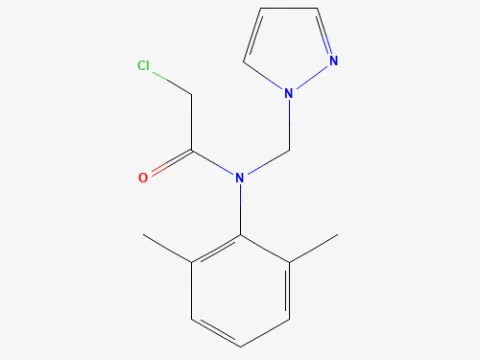
Metazachlor
Metazachlor belongs to the chloroacetanilide chemical class and acts as a highly effective selective herbicide. Its primary purpose is to suppress weeds at the earliest stages of their development.
What the section contains
Metazachlor
The mechanism of action is based on the inhibition of cell division and protein synthesis in susceptible weeds. The compound blocks metabolic processes in meristematic tissues, resulting in complete growth arrest.
Once in the soil, the active substance is actively absorbed by the root system and coleoptiles of germinating weeds. Efficacy depends directly on soil moisture levels, as the herbicide must be dissolved to penetrate plant tissues.
The herbicide exhibits high selectivity toward crop plants, which are capable of metabolizing metazachlor and converting it into harmless compounds within their own tissues.
In the soil, metazachlor undergoes microbial degradation and chemical hydrolysis, ensuring a moderate half-life and reducing the risk of carry-over effects in subsequent crop rotations.
The active ingredient is designed to control a wide spectrum of annual grasses and many broadleaf weeds. It is particularly effective against stubborn species that emerge early in the planting season.
Key targets for metazachlor include weeds such as barnyard grass, annual bluegrass, foxtail, as well as various species of amaranth and knotweed.
The preparation also demonstrates inhibitory effects on common chickweed, shepherd's purse, and scentless mayweed, making it indispensable for establishing rapeseed crops.
Effectiveness against broadleaf weeds may vary depending on the specific species and soil moisture conditions at the time of application.
- Barnyard grass (Echinochloa crus-galli)
- Annual bluegrass (Poa annua)
- Amaranth (Amaranthus spp.)
- Shepherd's purse (Capsella bursa-pastoris)
Application is usually timed with the sowing period — either pre-emergence or immediately after planting. Timely application is critical to provide maximum protection during the most vulnerable growth phase.
Dosage rates depend on soil type: on light soils with low humus content, rates are typically reduced, whereas on heavy or high-humus soils, dosages are increased to ensure a consistent herbicide barrier.
To achieve optimal results, the field surface must be well-prepared and free of large clods to ensure the herbicide layer is applied as evenly as possible.
In drought conditions, efficacy may decrease; therefore, if no rain follows the treatment, light incorporation into the soil is recommended to activate the active substance.
The herbicide can be used alone or in tank mixes, provided it is allowed by the product label, to broaden the spectrum of action against resistant weed species.
Application of metazachlor is not recommended under stress conditions for the crop, such as sharp temperature fluctuations or waterlogged soil.
It is crucial to consider the potential phytotoxicity for sensitive crops, requiring strict adherence to crop rotation plans and intervals between treatments on the same fields.
When handling the herbicide, users must strictly adhere to safety protocols, wearing protective clothing and respiratory protection during the preparation of the working solution.
Disposal of product residues into water bodies or sewage systems is strictly prohibited, as the substance can be toxic to aquatic organisms if it enters open ecosystems.
Storage should be conducted in original packaging in a cool, dry place, ensuring it remains inaccessible to unauthorized persons, children, and livestock.