
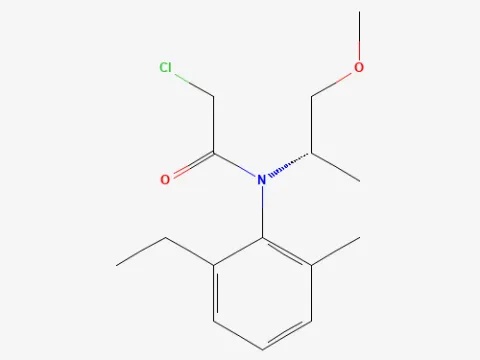
S-metolachlor
S-metolachlor belongs to the chloroacetanilide chemical class and acts as a selective herbicide with primary soil activity.
What the section contains
S-metolachlor
The active ingredient is absorbed primarily through the coleoptile of germinating weeds, effectively halting their development.
It inhibits the synthesis of proteins, lipids, and anthocyanins in plant tissues, which causes the cessation of cell division in the meristematic regions.
Being a more active isomer compared to the standard metolachlor, it provides superior efficacy at lower application rates.
The herbicide creates a chemical shield in the top layer of the soil, ensuring control of emerging weeds for several weeks.
S-metolachlor is primarily used to control annual grasses and specific small-seeded broadleaf weeds.
Key target species include crabgrass, foxtail species, barnyardgrass, and various pigweed species.
The herbicide is most effective against weeds that germinate from the top 3–5 cm of the soil profile.
It does not provide control over established perennial weeds that propagate via rhizomes or tubers due to its specific pre-emergence mode of action.
Effective management with this substance ensures that crops establish themselves without competition from early-season weed flushes.
Application rates must be adjusted based on soil texture and organic matter content, as higher clay or humus levels require higher doses.
Typical application ranges from 1.0 to 2.0 liters of formulated product per hectare, depending on the active ingredient concentration.
Timing is critical: the product should be applied pre-plant (with incorporation), at planting, or immediately post-planting before crop emergence.
Incorporation into the soil may be necessary if the surface is dry or if minimal rainfall is expected following application.
Tank mixing with other herbicides is common practice to broaden the spectrum of controlled broadleaf weeds in crops like maize or soybeans.
Soil moisture is a key factor; extreme drought conditions following application can result in reduced herbicide performance.
Usage on extremely sandy soils with very low organic matter content should be approached with caution to prevent potential leaching into the crop root zone.
When choosing this herbicide, always consider the crop rotation plan, although the residual effect usually dissipates before the next season.
Operators must adhere to strict safety protocols, including wearing appropriate personal protective equipment and avoiding direct skin or eye contact.
Environmental precautions are mandatory: prevent runoff into irrigation channels and water bodies to protect non-target aquatic environments.