
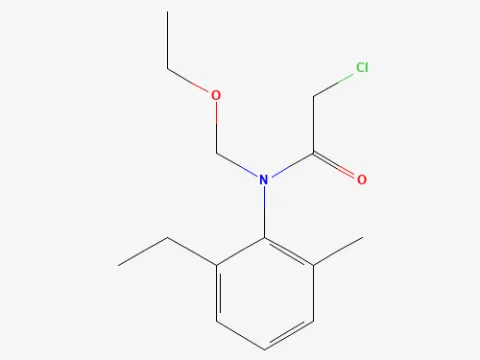
Acetochlor
Acetochlor belongs to the chloroacetanilide chemical class and acts as a highly effective selective systemic herbicide. The substance is actively absorbed by germinating seeds and the root system of weeds during their emergence phase.
What the section contains
Acetochlor
The primary mode of action is the inhibition of protein and nucleic acid synthesis within weed tissues. The compound blocks the activity of enzymes responsible for cell division, which leads to the immediate cessation of root and shoot growth.
The active ingredient exhibits significant residual activity in the soil, creating a protective barrier. This allows for the suppression of subsequent flushes of weeds that germinate within 4 to 8 weeks following application.
The effectiveness of the product is directly dependent on the soil moisture levels. Under optimal humidity, acetochlor distributes rapidly through the topsoil, ensuring uniform uptake of the active component by weed seedlings.
To activate the product in arid conditions, it is recommended to incorporate it into the soil at a depth of 2–3 cm. This ensures the active ingredient functions effectively even when rainfall is scarce after sowing.
Acetochlor is primarily used as a pre-emergence herbicide to control a wide spectrum of annual grasses and specific species of broadleaf weeds.
The most sensitive weed species include: foxtail grasses, barnyard grass, crabgrass, annual bluegrass, lambsquarters, pigweed species, and shepherd's purse.
The product demonstrates high efficiency in combating weeds that sprout from seeds in the upper soil profile before the crop plants emerge.
The agent effectively limits weed competition with the crop during the earliest, critical stages of organogenesis, when weeds are capable of causing the greatest yield loss.
It is important to note that acetochlor has limited efficacy against perennial weeds that reproduce vegetatively, which is why it is used as part of integrated protection programs.
Application rates vary from 1.5 to 3.0 liters (or kg) per hectare, depending on soil type and the density of weed infestation in the field.
For light (sandy) soils, the use of minimum dosages is recommended, whereas heavy loamy and high-humus soils require maximum rates to achieve satisfactory control.
The product is applied immediately after sowing the crop and before its first shoots appear. A critical requirement is thorough soil preparation: the field surface must be leveled and free of large clods.
The spray solution must uniformly cover the soil surface. The recommended spray volume is 200–300 liters per hectare using standard ground application equipment.
Application timing is strictly limited to the germination phase of weeds. Once the crop has emerged, applying pure acetochlor as a soil herbicide is no longer recommended.
The application of acetochlor in conditions of extreme soil saturation or when heavy rainfall is expected immediately after application is prohibited, as it may cause phytotoxicity.
It is not recommended to use the product on soils with less than 1% humus or on sandy soils with low adsorption capacity due to the risk of leaching into the root zone of the crops.
In the event of crop failure in fields treated with acetochlor, only crops resistant to this herbicide (such as corn) may be used for replanting.
When handling the substance, standard safety protocols must be followed: use personal protective equipment for skin, respiratory, and eye protection, and prevent any discharge into water bodies.
- Prevent drift of the product to neighboring sensitive crops.
- Maintain proper temperature conditions for container storage.
- Clean spray equipment thoroughly immediately after finishing operations.