
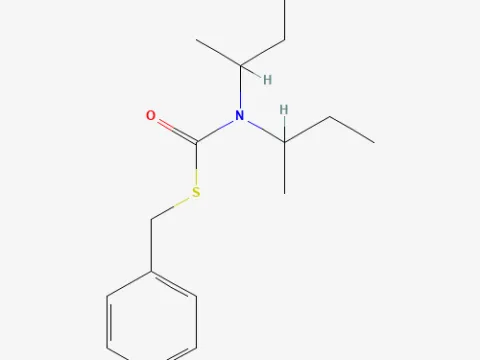
Tiocarbazil
Thiocarbazil belongs to the class of thiocarbamic acid derivatives, which are primarily employed as selective herbicides in modern agriculture. The primary mechanism of action involves the inhibition of protein and nucleic acid synthesis within the cells of target weeds.
What the section contains
Tiocarbazil
These compounds effectively block cell division in meristematic tissues, leading to the prompt cessation of weed growth. As a result, competitive pressure on crops is reduced significantly during the most sensitive early growth stages.
Acting as systemic agents, these substances are absorbed by the plant and translocated throughout its structure. This enables effective control even against weeds that have just begun to germinate in the soil profile.
Furthermore, the active substances disrupt lipid metabolism, leading to the degradation of cell membrane integrity. This physiological impact is the key factor in the rapid demise of susceptible plant species upon treatment.
The high biological activity of this group makes them essential tools in integrated pest management programs, provided that specific application requirements are meticulously followed.
This group of active substances is designed to control a broad spectrum of annual grasses and specific broadleaf weed species. They are particularly effective against graminaceous weeds such as barnyard grass and foxtail species.
Thiocarbazil-based formulations are frequently applied in crops like sugar beets, cereals, and other row crops. By establishing a chemical barrier in the soil, they prevent successive waves of weed emergence throughout the season.
The efficacy of the treatment is highly dependent on environmental variables such as soil moisture content and organic matter level. Under optimal conditions, these herbicides provide a consistent protective shield against weed competition.
Using these chemicals facilitates conservation tillage practices, helping to preserve soil structure and moisture levels while maintaining high standards of weed control in agricultural fields.
Agronomists should perform a weed survey prior to application, as the sensitivity of certain species can vary depending on the local environmental conditions and biological resistance levels.
Application rates for thiocarbazil compounds are determined by soil texture and organic matter content. Soils with higher clay content or organic matter may require higher dosage rates due to the increased adsorption of the active ingredient.
The timing of the application is critical; it is generally performed pre-planting with mandatory soil incorporation to a depth of 3–5 cm. This practice protects the active molecule from photo-degradation and excessive volatilization.
Temperature during application must be within recommended ranges to ensure maximum efficacy. Extreme heat can lead to rapid degradation or evaporation before the herbicide can interact effectively with weed seeds.
When used in tank mixtures, compatibility testing is required. These herbicides often show good synergy with other pre-emergent products, enhancing the overall spectrum of control against complex weed populations.
Field monitoring post-application is necessary to assess biological efficacy and to determine if subsequent interventions are required for optimal crop performance throughout the growing season.
Strict adherence to safety protocols is required when handling these chemicals. Personal protective equipment (PPE) must be worn to prevent dermal contact, inhalation, or ingestion of the concentrated product.
Environmental restrictions apply, particularly near water bodies. Applications must be avoided in areas susceptible to runoff to protect aquatic ecosystems from the toxic effects of the active substance.
Crop rotation considerations must be taken into account, as some residues may persist in the soil depending on environmental conditions and application rates, potentially affecting sensitive subsequent crops.
Weather conditions, specifically wind speed, are major constraints. Spraying must be performed under calm conditions to prevent spray drift onto non-target areas or sensitive adjacent crops.
Proper decontamination of spraying equipment after use is mandatory. Thorough washing with specialized cleaning agents prevents accidental chemical carry-over, ensuring that equipment is safe for subsequent use on other crops.