
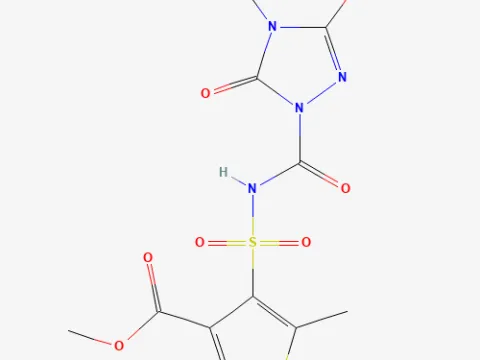
Thiencarbazone-methyl
Thiencarbazone-methyl belongs to the sulfonylaminocarbonyltriazolinone chemical class. It is a modern, highly effective active ingredient that functions as a systemic herbicide with significant soil and foliar activity.
What the section contains
Thiencarbazone-methyl
The primary mechanism of action involves inhibiting the acetolactate synthase (ALS) enzyme in plant organisms. Blocking this enzyme stops the synthesis of essential amino acids, namely leucine, isoleucine, and valine.
Once absorbed by weeds, thiencarbazone-methyl translocates rapidly through the phloem and xylem to active growth points. As a result, metabolic processes in susceptible weeds are disrupted, leading to plant death.
Crop plants such as maize are able to rapidly metabolize the substance into inactive compounds. This ensures high selectivity and safety for the crop when application regulations are followed.
Furthermore, the compound provides residual soil activity, which prevents the germination of new weed flushes for several weeks following the initial application.
Thiencarbazone-methyl is primarily used to control a wide spectrum of annual broadleaf weeds and some grasses in maize crops.
The ingredient effectively suppresses hard-to-control species such as amaranth, common lambsquarters, knotweeds, common ragweed, and various foxtail species.
Due to its systemic properties, the herbicide successfully eradicates weeds at early developmental stages as well as when they reach phases requiring intensive management.
- Amaranthus species
- Chenopodium album
- Polygonum species
- Ambrosia artemisiifolia
- Setaria species
The product shows excellent results in tank mixtures, which allows for a broader spectrum of action and an increased effect against overgrown weeds.
Application rates for thiencarbazone-methyl vary depending on the specific product formulation, weed species composition, and the growth stage of the maize crop.
Typically, applications are performed at the 2 to 5-6 leaf stage of maize, when weeds are actively growing and most vulnerable to the treatment.
The product can be used as a stand-alone solution or as part of integrated herbicide programs to ensure long-term field cleanliness.
When planning application schedules, it is essential to consider weather conditions; optimal efficacy is achieved when there is sufficient soil moisture to activate the soil-residual properties.
Application must be carried out using standard ground equipment that ensures uniform coverage of the weed foliage with the spray solution.
There are restrictions regarding follow-up crops in the rotation when using high doses of the product, requiring careful review of local guidelines.
It is not recommended to apply the herbicide if the crop is under stress due to frost, drought, excessive moisture, or damage from pests.
It is crucial to avoid spray drift onto neighboring fields with sensitive crops, as the high systemic activity can cause significant damage to non-target vegetation.
Adhering to temperature regulations and wind speed limits during spraying is critical to prevent losses of the active ingredient.
All activities involving pesticides must be conducted using individual protective gear for skin and respiratory protection in accordance with safety standards.