
Apion basicorne
Apion basicorne
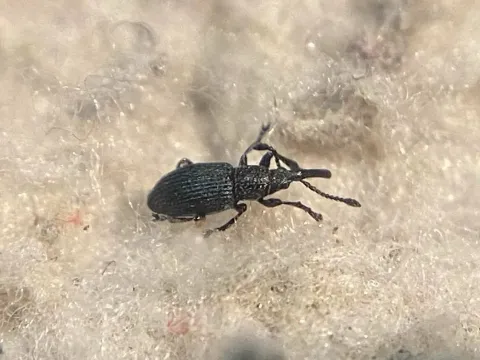
Apion basicorne is a small weevil belonging to the family Apionidae. The adult beetle is typically 2.5–3 mm long, with a dark, often metallic blue or black coloration, and a body covered with fine hairs.
What the section contains
Apion basicorne
The morphology of the rostrum (snout) is a key diagnostic feature, as it differs between males and females, allowing researchers and agronomists to identify the species during field scouting.
The larvae are legless, C-shaped, and possess a distinct, hardened head capsule. They develop primarily inside the reproductive parts of host plants, remaining hidden until the adult stage.
The pupal stage occurs inside the plant tissue or seed, where the insect is protected from environmental stressors and most common natural predators.
Adult beetles have hardened elytra, which provide durability and protection during their movement between host plant patches throughout the growing season.
This pest primarily attacks various legume crops, including peas and vetches. Adults feed on foliage and buds, while the larvae are internal feeders that destroy developing seeds within the pods.
Economic damage is substantial as the destruction of seeds directly reduces both the quantity and quality of the harvest. Infested seeds lose their commercial value and germination potential.
The activity of the larvae often creates entrance sites for secondary infections, such as fungi or bacteria, which further degrade the quality of the pulse crop.
High infestation rates can lead to a significant decrease in the overall yield, as the development of pods is disrupted and seed weight is drastically reduced.
In cases of severe infestation, the cumulative stress on the plant, combined with direct seed destruction, can lead to uneven ripening and harvesting difficulties.
Apion basicorne overwinters as an adult, typically seeking refuge in the soil, plant debris, or surrounding vegetation along field edges and hedgerows.
Emergence from hibernation occurs in the spring when ambient temperatures rise, allowing the beetles to migrate to available legume crops for feeding and reproduction.
The peak activity and egg-laying period coincide with the flowering and pod-setting stages of the host plants, which provides the necessary nutrition for the next generation.
Larval development progresses throughout the summer months. Depending on the climate, the species may complete one or more generations per growing season.
As the harvest period approaches and temperatures decrease, adults leave the host plants to find suitable overwintering sites, thus completing their annual life cycle.
Adult feeding damage is characterized by tiny circular or irregular holes in leaves, often referred to as 'shot-hole' or windowing damage, which is visible early in the season.
Detection of larval infestation is usually confirmed by inspecting the pods. Small entrance holes on the surface of the pods are the most common external sign of larval presence inside.
Opening the pods reveals the internal destruction of seeds, where the larva has consumed the tissue, leaving behind hollowed-out cavities filled with frass.
Plants affected by the pest often exhibit signs of physiological stress, including stunted growth, yellowing of pods, and premature senescence in heavily infested areas.
Field monitoring using sweep nets is highly effective for detecting the presence of adults before they begin egg-laying, allowing for timely preventative measures.
Implementing a diverse crop rotation is a primary defense, as it helps break the pest's life cycle by eliminating host plants in the field for consecutive seasons.
Deep autumn plowing is a recommended cultural practice to disrupt overwintering sites, burying the adults or exposing them to harsh winter conditions and predators.
Timely harvesting of the crop is crucial to minimize the time the larvae spend inside the seeds and to prevent the emergence of a new generation of adults in the storage facilities.
If economic injury levels are exceeded, the use of registered systemic or contact insecticides may be necessary to suppress populations during critical growth stages.
Always adhere to local integrated pest management (IPM) guidelines, ensuring that chemical treatments are applied only when necessary and in accordance with safety regulations.