
Apion occidentale
Apion occidentale
Description
How to identify
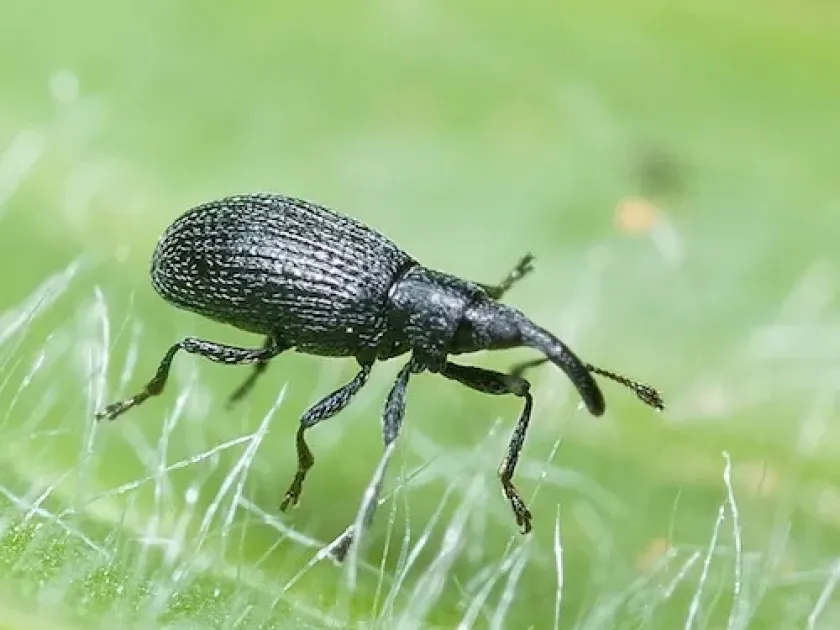
Apion occidentale is a small beetle belonging to the order Coleoptera and the family Brentidae (often referred to as Apionidae). These insects are recognized for their distinct, elongated snouts, which are typical of weevils.
Adult beetles are quite small, generally measuring between 2 and 3 millimeters in length. Their bodies are characteristically pear-shaped, and they typically possess a dark, often black or brownish, matte appearance.
The larvae of this species are legless and have a curved, creamy-white body with a well-developed, sclerotized brown head capsule. They are strictly endophagous, meaning they develop hidden within the plant tissue.
The pupae are also found within the host plant, often inside the stem or near the head, enclosed in a small chamber created by the larva before pupation begins.
Adults are capable fliers, which facilitates their movement between host plants in the field. They are highly efficient at locating suitable host plants for feeding and subsequent oviposition during the growing season.
What it damages
The primary host plant for Apion occidentale is sunflower. While they can feed on various members of the Asteraceae family, they are most notable as pests in sunflower cultivation.
Adult feeding involves creating small, circular punctures in the leaf surface and tender tissues of the plant. While this damage rarely kills the plant, it reduces photosynthetic efficiency and overall plant vigor.
The most significant damage is caused by the larvae, which tunnel into the stalks, leaf petioles, and the base of the sunflower head. This feeding destroys the vascular tissue and disrupts the flow of nutrients and water.
Stems damaged by larvae become structurally weakened, making them susceptible to lodging during windy conditions. Furthermore, the tunnels provide entry points for secondary fungal infections and bacterial rots.
Crop loss results from a reduction in head size and weight, as well as lower seed filling. In severe infestations, the yield loss can be significant, directly impacting the profitability of the sunflower crop.
When it appears
Adult beetles typically emerge from overwintering sites in early spring, as temperatures rise consistently above 12–14 degrees Celsius, coinciding with the seedling stage of sunflower growth.
The peak activity of the beetles and the subsequent egg-laying phase occur during the vegetative development and early reproductive stages of the sunflower, usually late spring to early summer.
The insect typically completes one generation per year. As the crop matures, the larvae complete their development and pupate within the plant, with the new generation emerging in late summer.
These new adults then seek out suitable overwintering habitats, such as soil debris, leaf litter, or nearby vegetation and forest edges, to survive the winter months.
The duration and intensity of the infestation can be highly dependent on regional climate patterns, with mild, early springs often leading to higher pest pressure in the field.
Signs of infestation
Early warning signs of an infestation include the appearance of numerous small, pinpoint holes on the foliage, which are the direct result of adult feeding activities on the leaves.
A more severe indicator is the premature yellowing and wilting of the plant, which often occurs despite adequate soil moisture, signaling internal damage to the plant's vascular system.
On closer inspection, one might notice distortions or small exit holes on the main stem, indicating that a larva has completed its development and emerged as an adult.
Infected fields may show patches of stunted or weaker plants compared to the rest of the crop. These patches are often the focal points of the initial infestation by overwintered adults.
Dissecting the stems of symptomatic plants is the most reliable way to confirm the presence of larvae or tunnels, allowing farmers to distinguish this pest from other causes of crop decline.
Control measures
Cultural control is the cornerstone of management. Rotating sunflower crops with non-host species and maintaining significant distance from previous-year fields are essential for reducing early infestation rates.
Deep autumn plowing of sunflower stubble is highly recommended, as it buries the overwintering adults and crop debris deep in the soil, effectively preventing them from emerging in the spring.
Chemical control involving systemic insecticides is necessary when infestation levels reach the economic threshold, as these treatments can penetrate the plant tissue where the larvae feed.
Weed management, especially the removal of wild Asteraceae species in and around fields, is vital to eliminate alternative food sources and breeding sites for the weevils.
Monitoring the fields during the early stages of sunflower development is critical. Early detection allows for timely intervention, which significantly reduces the need for extensive insecticide applications later in the season.
Taxonomy
- Latin name
- Apion occidentale
- Order
- Coleoptera (beetles)
- Family
- Apionidae
- EPPO code
- APIOOC
Discussion
No discussions yet — be the first.