
Apion gracilipes
Apion gracilipes
Description
How to identify
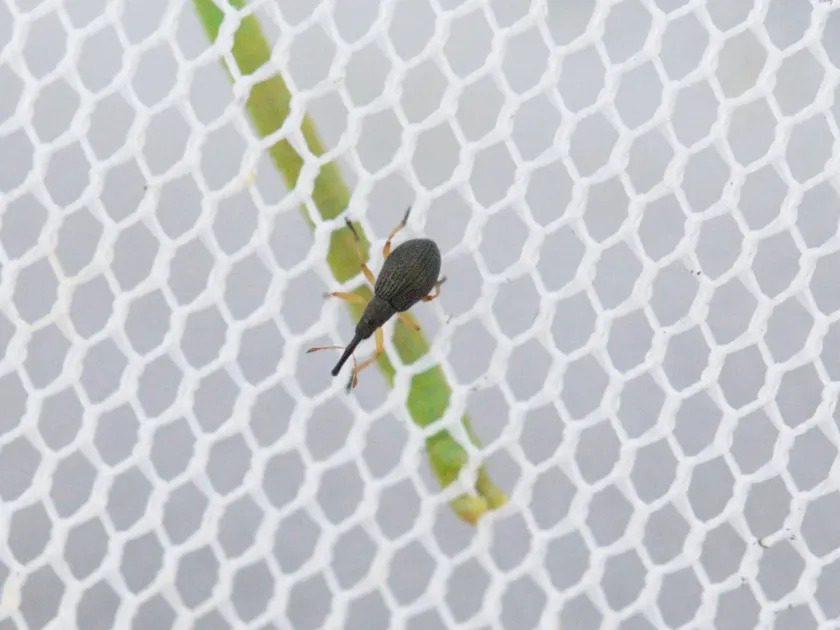
Apion gracilipes is a small beetle belonging to the Apionidae family. These insects are typically 2-3 mm long, characterized by a distinct pear-shaped body and a long, slender rostrum or snout.
The adults are usually dark blue or black with a subtle metallic sheen. Their bodies are sparsely covered with fine, short hairs, and they possess thin legs, which inspired their common scientific name.
The larvae are legless, white, and have a C-shaped body with a hardened, brown head capsule. Because they develop entirely inside the reproductive parts of the host plants, they are rarely seen by farmers during routine inspections.
Adults are highly mobile and capable of flight, which allows them to colonize new fields of leguminous crops, particularly clover, very rapidly during the spring and early summer.
The taxonomic classification places them within the Coleoptera order, where they serve as significant specialized pests that target the reproductive structures of forage legumes.
What it damages
The primary damage is caused by both adults and larvae feeding on the generative parts of plants. They show a strong preference for various species of clover, which can be severely impacted by their feeding habits.
Adult beetles feed on leaves and young buds, creating small, characteristic puncture holes. This defoliation reduces the photosynthetic capacity of the plant and weakens its overall growth and vigor.
The larvae are responsible for the most severe damage as they bore into the buds and ovaries, consuming the developing seeds. This leads to complete seed loss and reduces the yield of seed-producing fields significantly.
The presence of this pest often leads to the deformation of flower heads and premature abscission of buds, which directly impacts the reproductive success and seed quality of the leguminous crops.
Secondary infections, such as fungal pathogens, can also enter through the wounds caused by the feeding larvae, further compromising the quality of the harvested biomass or seed crop.
When it appears
Adults overwinter in protected areas such as hedge rows, thick grass, or crop residues. They emerge in the early spring as temperatures rise, preparing for the upcoming reproductive season.
The active feeding and mating period occurs simultaneously with the budding phase of clover. During this time, they migrate to the host plants to begin the egg-laying process within the buds.
After the eggs are laid, the larvae develop inside the flower heads for approximately 2 to 3 weeks. They pupate within the same host structure before emerging as a new generation of adults in mid-summer.
These new adults remain active until late summer or autumn, continuing to feed and potentially expanding the infestation to late-flowering plants before seeking overwintering sites.
The life cycle is tightly synchronized with the development of the host plant, making the timing of monitoring and control interventions critical for effective crop management.
Signs of infestation
The most visible sign of an infestation is the presence of numerous small holes in the foliage and flower bracts. Heavily infested fields may appear stunted or visually distressed.
Deformed, brown, or prematurely dropped buds are clear indicators of larval activity. If a damaged flower head is dissected, small larvae or dark, granular frass can usually be found inside.
The absence of seeds within the pods or significantly reduced seed set at harvest is a definitive sign of Apion gracilipes activity, often mistaken for other causes of poor yields.
The overall thinning of the canopy and the loss of floral parts can lead to an uneven appearance in clover stands, making them easily identifiable to an experienced agronomist.
Monitoring for adults with a sweep net during the early budding stage is the most reliable way to detect the onset of an infestation before the larvae reach the destructive stage.
Control measures
Cultural control strategies include maintaining proper spatial isolation between seed crops and older clover stands to break the pest's reproductive cycle and limit migration.
Deep autumn plowing is a recommended mechanical practice, as it helps to destroy the overwintering sites of the adults, significantly reducing the population density for the following year.
Chemical control should be implemented based on economic thresholds. Insecticide applications are most effective when timed to target the adults before they can deposit eggs into the developing flower buds.
Biological control methods involve preserving native predator and parasitoid populations, which can provide natural suppression of the beetle population within the ecosystem.
- Early mowing of forage stands to interrupt larval development.
- Regular field scouting during the budding stage to monitor beetle numbers.
- Use of crop rotation to reduce pest accumulation in specific areas.
Taxonomy
- Latin name
- Apion gracilipes
- Order
- Coleoptera (beetles)
- Family
- Apionidae
- EPPO code
- APIOGR
Discussion
No discussions yet — be the first.