
Apion vorax
Apion vorax
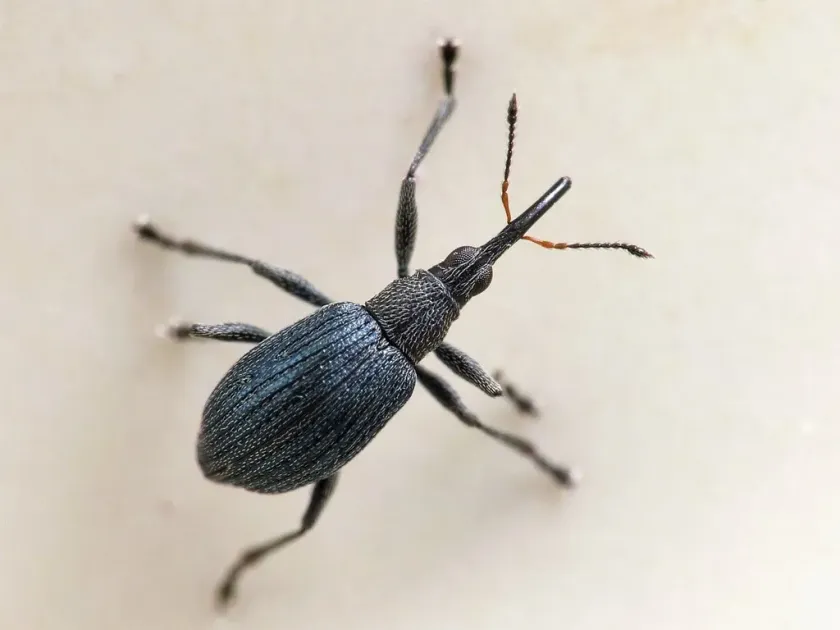
Description
How to identify
Apion vorax is a small beetle belonging to the Apionidae family, commonly referred to as a seed weevil. Adults typically measure between 2 to 3 mm in length and are recognized by their distinct pear-shaped bodies, which are usually black with a slight metallic or glossy sheen.
A key identifying feature of this pest is the long, slender, and slightly curved snout (rostrum), which is used for both feeding on plant tissues and drilling precise holes for egg-laying. The beetle's structure is highly adapted for an endophytic lifestyle.
Larvae are legless, curved, and generally cream-colored with a darker, chitinized head capsule. They spend their entire developmental period hidden inside the reproductive structures of the host plants, making them difficult to detect without dissection.
These insects are capable of flight and exhibit strong dispersal abilities during the growing season. As adults, they are resilient and are well-adapted to surviving the winter by entering diapause in protected soil cavities or under dense leaf litter.
Taxonomically, the species is part of the Coleoptera order. Understanding its life cycle and seasonal activity is essential for distinguishing it from other similar seed weevil species that may share the same host plants in an agricultural landscape.
What it damages
Damage caused by Apion vorax involves both adults and larvae. Adult beetles chew small, distinct holes in the leaves, often described as a "shothole" pattern, which reduces the plant's photosynthetic efficiency and stunts vegetative growth.
The most significant economic damage occurs during the reproductive stage of leguminous crops. Larvae burrow into flower buds and developing seeds, consuming the internal tissues and rendering the seed material non-viable or significantly lowering its quality.
Severe infestations can lead to flower drop, pod deformation, and a substantial reduction in seed yields. In seed production fields, this pest can cause losses that threaten the profitability of the entire crop if not managed timely.
Host plants primarily include perennial legumes such as clover, alfalfa, and sainfoin. These crops are particularly susceptible because they provide a stable, multi-year environment that allows the pest population to build up over successive seasons.
Mechanical feeding by adults also creates entry points for secondary pathogens, such as fungi or bacteria, which can further degrade the health of the crop canopy and lead to premature senescence of the affected plants.
When it appears
The emergence of adult beetles from their overwintering sites begins in early spring as temperatures rise, typically when soil and air temperatures reach 8-10 degrees Celsius. This marks the start of the primary infestation period.
Adults immediately begin feeding on fresh vegetation to gain the energy needed for reproduction. Following mating, females lay eggs inside the buds or ovaries of the host plants, ensuring that larvae have an immediate food source upon hatching.
Larval development occurs throughout late spring and early summer, progressing through several instars. The pupal stage also takes place within the plant tissues, leading to the emergence of a new generation of adults by mid-summer.
The second generation of adults remains active throughout the summer, feeding on vegetative parts and potentially secondary host species. As autumn temperatures drop, they seek refuge in the soil or under debris to prepare for the winter diapause.
Effective monitoring should be intensified during the budding and early flowering phases. This is the period when the crop is most vulnerable and when chemical control interventions, if required, are most effective against the adult population.
Control measures
Cultural control is the cornerstone of managing Apion vorax. Avoiding continuous monocropping of legumes on the same site for more than three years helps prevent the pest population from reaching economically damaging levels.
Deep plowing in the autumn is a highly effective agronomic practice. By burying crop residues, the larvae and pupae within are destroyed, and overwintering adults are exposed to unfavorable conditions, significantly reducing the starting population for the next season.
Timely harvesting or mowing of fodder legumes can disrupt the life cycle of the weevil. Cutting the plants before the larvae reach maturity effectively eliminates the next generation and limits the spread of the pest across the farm.
Chemical control is warranted when pest density exceeds the economic threshold. Insecticides belonging to pyrethroid or neonicotinoid classes are commonly used, provided they are applied in accordance with local regulations to minimize impact on beneficial pollinators.
- Use crop rotation to break the pest's life cycle.
- Perform deep soil cultivation after harvest.
- Monitor populations using sweep nets.
- Ensure insecticide applications occur during non-flowering hours to protect bees.
- Keep field edges free of wild leguminous weeds.
Taxonomy
- Latin name
- Apion vorax
- Order
- Coleoptera (beetles)
- Family
- Apionidae
- EPPO code
- APIOVO
Discussion
No discussions yet — be the first.