
Apion tenue
Apion tenue
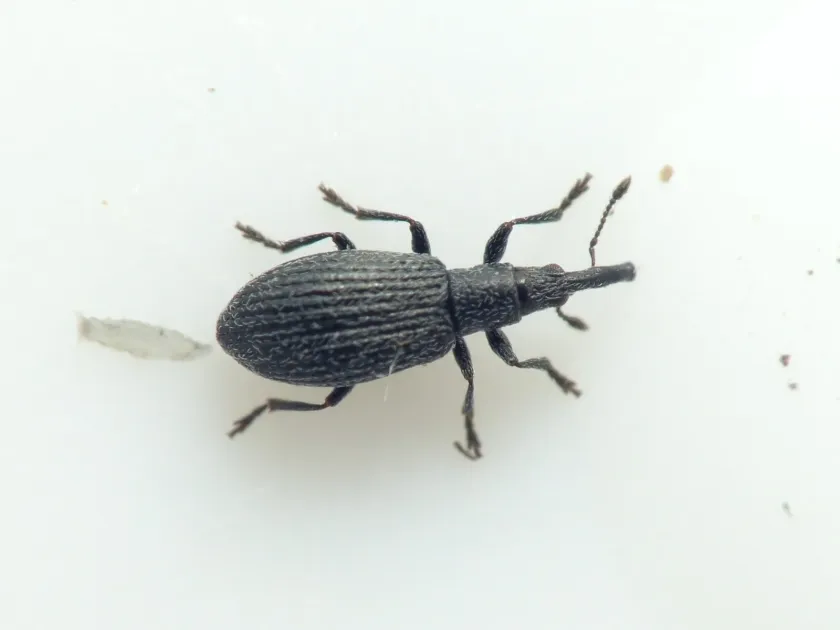
Description
How to identify
Apion tenue is a small beetle belonging to the family Apionidae, within the order Coleoptera. It is a specialized pest primarily affecting various leguminous plants.
The adult beetle measures about 2 to 2.5 mm in length. Its body is elongated, usually black or dark brown, sometimes with a faint metallic sheen and sparse hair coverage.
A distinctive feature of this species is its long, slender snout, known as the rostrum, which is characteristic of the Apionidae family. This structure is essential for feeding and oviposition.
The larvae are typically legless, curved, and whitish in color with a darker head capsule. They are exclusively internal feeders, spending their entire larval development inside the host's seeds.
Due to their small size and cryptic habits, identifying them requires careful field observation, often involving sweep-net sampling during the flowering and seed-setting stages of the host crops.
What it damages
The primary hosts for Apion tenue are leguminous crops, with alfalfa being the most frequently and severely damaged. This makes it a significant pest for seed production industries.
Adult beetles cause damage to leaves and stems by creating small, round feeding punctures, which can weaken the plant's overall photosynthetic capacity during the early growing season.
The most severe damage is caused by the larvae, which burrow into the developing pods and consume the contents of the seeds. This leads to complete destruction of the seed embryo.
Economic losses are significant as infested seeds lose their germination potential and market value. Furthermore, the presence of damaged pods reduces the total harvestable yield.
In addition to direct crop loss, the weakened state of the plants makes them more susceptible to secondary fungal infections or environmental stress factors during the growth cycle.
When it appears
Adults overwinter in soil, plant debris, or nearby hedgerows and field margins. They emerge in early spring once temperatures rise consistently above 10-12 degrees Celsius.
Initial feeding takes place on overwintering alfalfa foliage. After a period of maturation feeding, the beetles mate, and females begin the process of laying eggs in the developing pods.
Larval development takes place entirely within the seed. Depending on temperature and moisture conditions, the developmental cycle from egg to adult takes several weeks to complete.
Pupation occurs within the seed or soil, followed by the emergence of the new generation of adults. These adults then engage in supplemental feeding before preparing for overwintering.
The timing of the pest's activity is highly synchronized with the reproductive phase of the legume crop, making the flowering and pod-filling periods critical for risk management.
Signs of infestation
Initial signs of infestation appear as tiny pinprick holes on the leaves, indicating the feeding activity of adult beetles. These signs are visible early in the season.
Pod deformation, premature yellowing, and abnormal shrinking of the legumes during the seed-filling stage are strong indicators of larval infestation inside the pods.
Dissecting the pods reveals the presence of partially or completely hollowed seeds, often accompanied by the larva itself or frass (excrement) left behind during the feeding process.
In fields with high population densities, visual inspection of the canopy may show uneven development and patchy areas where the plant vigor is visibly lower than in healthy sections.
Exits holes on the outer surface of mature seeds serve as a clear sign that the adult beetles have successfully completed their development and emerged from the pods.
Control measures
- Maintain spatial separation between new legume fields and existing stands to reduce migration rates.
- Use certified, high-quality, and clean seed material to prevent the introduction of the pest into new areas.
- Practice deep autumn plowing to disturb the soil and destroy the overwintering sites of the adult beetles.
- Harvest alfalfa for seed at the optimal time to remove infested pods before the larvae complete their development.
- Apply systemic insecticides according to economic threshold levels, ensuring timing coincides with the period of peak beetle activity.
Taxonomy
- Latin name
- Apion tenue
- Order
- Coleoptera (beetles)
- Family
- Apionidae
- EPPO code
- APIOTE
Discussion
No discussions yet — be the first.