
Alfalfa seed curculio
Holotrichapion pullum
Description
How to identify
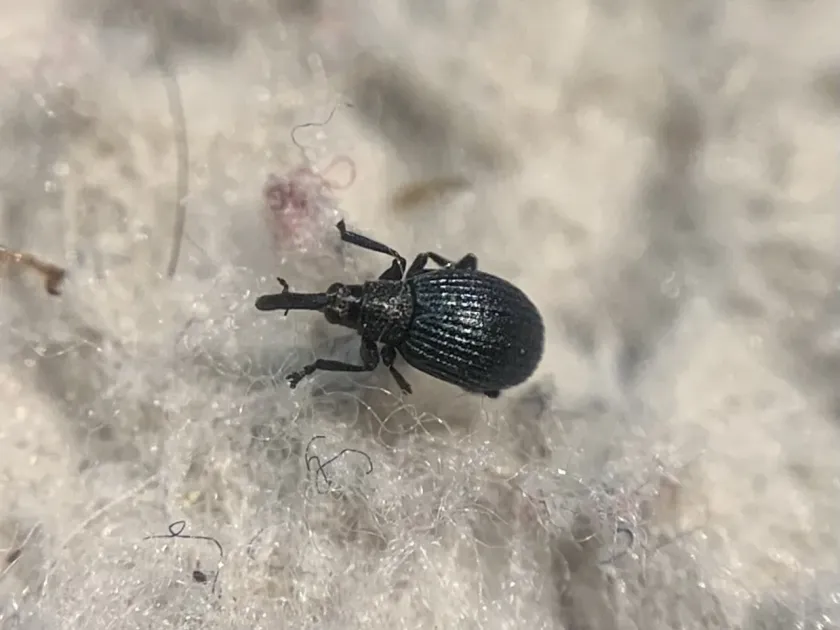
The alfalfa seed curculio (Holotrichapion pullum) is a small beetle belonging to the family Brentidae. Measuring approximately 2–2.5 mm in length, these beetles are characterized by a dark, metallic-black, oval-shaped body.
A distinctive feature of this species is its thin, slightly curved snout (rostrum), which it uses to feed on plant tissues and drill holes into buds to lay eggs. The larvae are legless, white-colored, and spend their entire developmental cycle inside the plant's reproductive organs.
Adult beetles overwinter in the upper soil layers, under leaf litter, or within alfalfa fields. As temperatures rise in the spring, they emerge to begin feeding on the first new growth of the host plant.
The life cycle is tightly synchronized with the flowering and budding stages of the alfalfa plant, ensuring the larvae have an immediate food source upon hatching.
Commonly found in temperate regions where alfalfa is grown for seed, this pest is a significant concern for commercial seed producers who rely on intact floral structures for harvest.
What it damages
The alfalfa seed curculio primarily attacks alfalfa fields grown for seed production. Adults cause damage by feeding on buds, young leaves, and developing flowers, which can stunt plant growth.
The most severe damage is caused by the larvae, which burrow into the flower buds and consume the reproductive tissues, completely destroying the seed potential of the infected florets.
Infected buds typically fail to open, turn brown, and eventually drop off the plant, leading to a significant decrease in seed yield and overall crop vitality.
Persistent feeding by adults during the early vegetative stage can lead to reduced plant vigor, making the alfalfa more susceptible to drought and secondary pathogens.
High infestations can lead to a substantial loss of the entire seed crop, rendering the fields unprofitable if control measures are not implemented during the peak migration period.
When it appears
Adult beetles begin to emerge from their overwintering sites in early spring, typically once soil temperatures stabilize above 10–12 degrees Celsius, aligning with the spring regrowth of alfalfa.
The peak period of damage and larval development occurs during the late budding to early flowering stages, which are the most critical times for the plant's reproductive success.
Emergence of the new generation of adults occurs in mid-to-late summer, after which the beetles seek shelter in soil or plant debris to enter diapause for the upcoming winter.
Weather conditions significantly impact the population dynamics, with warm and humid springs promoting rapid larval development and higher survival rates for the new generation.
As autumn approaches, the activity of the beetles decreases significantly, and the population concentrates in protected areas, preparing to survive the winter months in a dormant state.
Signs of infestation
Early signs of infestation include small, circular feeding punctures on the foliage and the presence of withered, discolored buds that fail to develop into flowers.
A close inspection of the field often reveals a high density of damaged, blackened buds that have prematurely aborted from the flower clusters.
When infected buds are dissected, the legless, white larvae can be found inside, surrounded by larval excrement, confirming the presence of the seed curculio.
- Stunted or deformed growth of apical shoots.
- Premature shedding of flower buds.
- Visible pinholes on leaves from adult feeding.
- Lower seed set and quality in harvested pods.
A widespread "browning" of the flower heads in an alfalfa field is a strong indicator of a high infestation that requires immediate agronomic action to save the remaining crop.
Control measures
Agrotechnical management includes early harvesting of the forage for hay, which can destroy the larvae inside the buds before they complete their life cycle.
Maintaining proper spatial isolation between new seed crops and older alfalfa stands helps reduce the migration of overwintering beetles into new fields.
Chemical control involves the application of appropriate insecticides during the bud stage, timed to target the adult beetles before they lay a significant number of eggs.
Integrated Pest Management (IPM) practices, including the use of pheromone traps for monitoring and the encouragement of natural predators, are recommended for sustainable control.
Regular scouting is essential; once the economic threshold of adult beetles is reached, targeted insecticide sprays are the most effective way to prevent catastrophic yield losses in seed fields.
Taxonomy
- Latin name
- Holotrichapion pullum
- Order
- Coleoptera (beetles)
- Family
- Apionidae
- EPPO code
- APIOAT
Discussion
No discussions yet — be the first.