

Pest · Diptera (flies) · affects Winter wheat, Winter barley, Fodder beet
Especially harmful
Chloropid flies
Chloropidae
Description
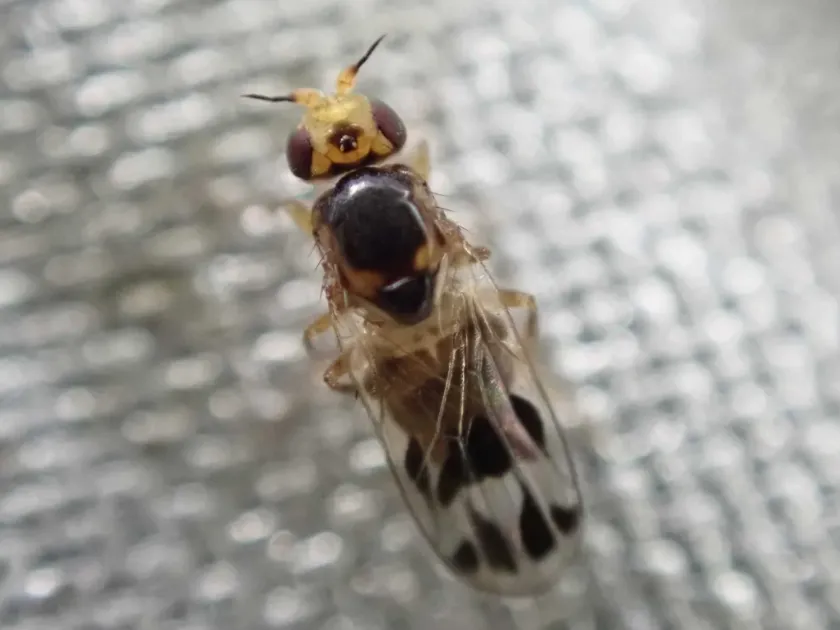
How to identify
Chloropid flies (family Chloropidae, order Diptera) are small, often yellow, black, or striped flies, typically ranging from 2 to 3 mm in length.
The larvae are small, legless, and cylindrical, usually white or yellowish. They possess specialized mouthparts called cephalopharyngeal hooks to scrape plant tissues.
The life cycle is complete, consisting of egg, larva, pupa, and adult stages. Many species within this family overwinter as larvae or puparia in plant stalks or debris.
They are widely distributed and thrive in various environments, often becoming serious pests in intensive agricultural landscapes.
While many species exist, they share similar habits of attacking graminaceous plants, making them a consistent challenge for agronomists worldwide.
What it damages
These flies primarily attack cereal crops, causing damage during their larval stage by feeding on internal plant tissues.
Common host plants include barley, wheat, rye, and oats. Other crops like soybean, oilseed rape, sunflower, and hemp can occasionally be affected.
In some agricultural systems, these pests have also been documented on fodder beet, garden cabbage, and common hop, though these are secondary hosts compared to grasses.
The most severe damage occurs at the tillering stage, where the larva consumes the growing point of the stem, often resulting in the death of the main shoot.
During the heading stage, the larvae can damage the developing ear, leading to empty grains or the characteristic "white-head" symptom.
When it appears
Adults emerge in early spring as soon as temperatures exceed 10-12 degrees Celsius, coinciding with the early development of cereal crops.
The number of generations depends on local climate, with multiple cycles possible in warmer regions during a single growing season.
The autumn generation is critical, as it targets winter crops, allowing larvae to enter the stems and survive the winter period inside the plant.
Weather conditions like excessive spring humidity or extended periods of moderate temperatures can lead to population spikes, increasing the risk of infestation.
Monitoring for adult flight periods is essential for timing interventions, as the window for effective chemical control is relatively short.
Signs of infestation
Early infestation is characterized by the wilting and yellowing of the central leaf in young tillering plants, often called "dead heart".
Upon careful inspection of the damaged stem, one can find the feeding tunnels and the small, yellowish larvae inside the main stem.
As the plant matures, damage manifests as distorted stems and the development of "white-heads," where the ear fails to fill or develop properly.
Severely infested fields show patchy growth, with weakened plants that are more susceptible to secondary fungal infections or lodging.
The overall reduction in plant vigor and biomass significantly affects the potential yield, particularly in high-density cereal stands.
Control measures
Effective management starts with cultural practices, such as crop rotation and maintaining a sufficient distance from previous years' cereal fields.
Post-harvest stubble cultivation and deep plowing are crucial to destroy overwintering larvae and puparia present in the soil and residues.
Adjusting sowing dates to avoid the peak flight periods of the flies can significantly reduce the level of primary infestation.
Chemical control involving systemic insecticides is recommended when infestation levels exceed economic thresholds, particularly during the early tillering phase.
Promoting vigorous plant growth through proper fertilization helps the crop withstand light infestations and compensates for potential tissue loss.
In brief
24
Damages crops
Content graph
Damages crops · 24
Content graph
Connections · Chloropid flies
Most often together:
Nutrient elements
1 contact
Marketplace
Products · 370
All 370
Insecticides, Acaricides 349
Herbicides, Desiccants 6
Fungicides 6
Sunflower 3
Wheat 3
Plant Growth Regulators 1
Barley 1
Triticale 1


Fortran, k.e., (dichlorvos, 400 g/l)
Санрайз Кемікалз Ко. Лтд., Шанхай, Китай
Insecticides
0
0
·
53
1 offer
69.12 €per pack
Buy

Pilarmax EC, (dichlorvos, 400 g/l)
Піларквім (Шанхай) Ко., Лтд. (Pilarquim (Shanghai) Co, LTD), Шанхай, Китай
Insecticides
0
0
·
53
1 offer
152 €per 1 l
Buy
Super Bison
«Юнісіті Ентерпрайсіс Л.П.», Единбург, Великобританія
Insecticides
0
0
·
53
10 offers
5.98 €per 1 l
Buy

Dimethoate EC
«Hunan Haili Chemical Industry Co., Ltd», Hunan, Китай
Insecticides
0
0
·
53
11 offers
1.22 €per 1 l
Buy


Zali, EC, Insecticide
Ф.Меатон Лімітед, Лондон, Великобританія.
Insecticides
0
0
·
53
3 offers
0.89 €per 1 l
Buy


Espada
ДВА Кемікалс Ко. Лтд., Китай (DVAChemicalsCo.Ltd.),China;
Insecticides
0
0
·
52
1 offer
37.67 €per 1 l
Buy


Zalp
«Юнісіті Ентерпрайсіс Л.П.», Единбург, Великобританія
Insecticides
0
0
·
52
3 offers
1.49 €per 1 l
Buy


Status, CS
«Нанджин Ессенс Файн-Кемікал Ко. Лтд» (Китай)
Insecticides
0
0
·
51
2 offers
45.48 €per 1 l
Buy

Canonir Ultra
Jiangsu Changqing Biotechnology Co., Ltd.
Insecticides
0
0
·
51
20 offers
3.65 €per 1 l
Buy


Insecticide preparation «Chlorpirifit-agro», a.e., (chlorpyrifos 50
«Нанджин Ессенс Файн-Кемікал Ко. Лтд» (Китай)
Insecticides
0
0
·
51
3 offers
7.75 €per 1 l
Buy




RECORD-TRIO
«Нанджин Ессенс Файн-Кемікал Ко. Лтд» (Китай)
Insecticides
0
0
·
50
1 offer
8.42 €per 1 l
Buy

SkoroBei-Zorya
LLC "SCIENTIFIC-PRODUCTION ENTERPRISE "UKRA"
Insecticides
0
0
·
50
1 offer
3.42 €per 1 l
Buy

Hunter
ТОВ «Фабрика агрохімікатів», Черкаси, Україна
Insecticides
0
0
·
50
2 offers
11.96 €per 1 l
Buy


Douglas c.e.
China Chemical Industrial & Rice Co. Ltd
Insecticides
0
0
·
48
2 offers
1.06 €per 1 l
Buy

Commander Grand
Белоцерковский завод препаративных форм
Insecticides
0
0
·
48
29 offers
2.06 €per 1 l
Buy


Taipro Protect
Hangzhou Ruijiang Chemical Co., Ltd.
Insecticides
0
0
·
48
2 offers
6.65 €per 1 l
Buy

ATO «ZHUK»
ТОВ «Фабрика агрохімікатів», Черкаси, Україна
Insecticides
0
0
·
48
34 offers
14.57 €per 1 l
Buy


Kaiser t.n.
Джі Ді Ес Кемікал Ко., Лтд., Джиангсу, Китай
Insecticides
0
0
·
47
1 offer
2.5 €per 1 l
Buy

Initer 600 TN
Фадер Альянс Лтд., Великобританія (Fader Alliance Ltd., England) на заводах Нідерландів, Польщі
Insecticides
0
0
·
46
1 offer
92.29 €per pack
Buy

Biology
Taxonomy
- Latin name
- Chloropidae
- Order
- Diptera (flies)
- Family
- Chloropidae
- EPPO code
- 1CHLOF
Community
Discussion
No discussions yet — be the first.