

Root-knot nematode
Meloidogyne sp.
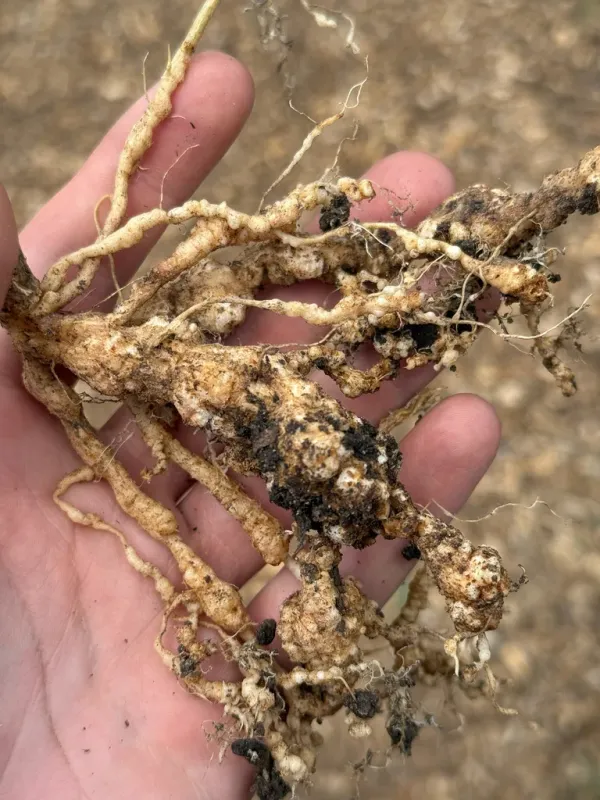
Description
How to identify
The root-knot nematode (Meloidogyne sp.) is a microscopic worm within the family Meloidogynidae, order Tylenchida. They are obligate endoparasites that inhabit the root tissues of host plants.
The life cycle involves the egg, four juvenile stages, and the adult stage. The second-stage juveniles (J2) are the infectious forms that migrate through soil moisture to find host roots.
Once inside the root, the nematode induces the formation of multinucleate giant cells, which serve as its primary source of nutrition throughout its life.
Females are sedentary and pear-shaped, laying hundreds of eggs in a gelatinous matrix that protects them from external environmental stressors.
They are primarily spread through infested soil, contaminated tools, machinery, and water runoff, making greenhouse hygiene crucial for management.
What it damages
Root-knot nematodes have a vast host range, attacking thousands of plant species, including major vegetables like tomatoes, cucumbers, and peppers.
The feeding activity within the roots significantly disrupts the plant's vascular system, hindering the uptake of essential nutrients and water from the soil.
This parasitic interaction causes the characteristic galls (knots) that interfere with plant growth, leading to stunting and severe loss of crop vigor.
Plants suffering from high nematode populations are often more susceptible to secondary soil-borne pathogens, such as Fusarium or Rhizoctonia fungi.
The economic impact is profound, especially in greenhouse environments where consistent yields are required for commercial profitability.
Signs of infestation
The most diagnostic sign is the presence of characteristic root galls or swelling on the root systems, which can be seen upon careful examination of the roots.
Above-ground symptoms include progressive wilting, leaf yellowing (chlorosis), and poor development, often appearing as patches in a field or greenhouse.
Plants often exhibit signs of nutrient deficiency, as the damaged root system is unable to provide adequate minerals regardless of fertilization levels.
In hot weather, the infected plants tend to wilt more rapidly than healthy plants because the compromised roots cannot meet the transpiration demands.
Yield reduction is significant, resulting in smaller fruit size, lower overall biomass production, and, in severe cases, premature senescence and plant death.
Control measures
Effective management begins with prevention, including the use of certified nematode-free transplants and rigorous cleaning of all farming equipment.
Cultural practices like crop rotation with non-host species or antagonistic plants (e.g., marigolds) are essential for long-term population suppression.
Soil solarization or steam sterilization in greenhouse settings can drastically reduce nematode populations before planting a new crop.
- Biological control using fungi such as Paecilomyces lilacinus.
- Application of chemical nematicides following local regulatory guidelines.
- Strict weed control to eliminate alternative hosts that sustain the population.
Regular monitoring of plant roots during the growing season allows for early detection of hotspots and implementation of targeted control measures.
In brief
1
Damages crops
Content graph
Damages crops · 1
Content graph
Connections · Root-knot nematode
Most often together:
Marketplace
Products · 14





Biology
Taxonomy
- Latin name
- Meloidogyne sp.
- Order
- Nematodes
- Family
- Meloidogynidae
- EPPO code
- MELGSP
Community
Discussion
No discussions yet — be the first.