

Description
How to identify
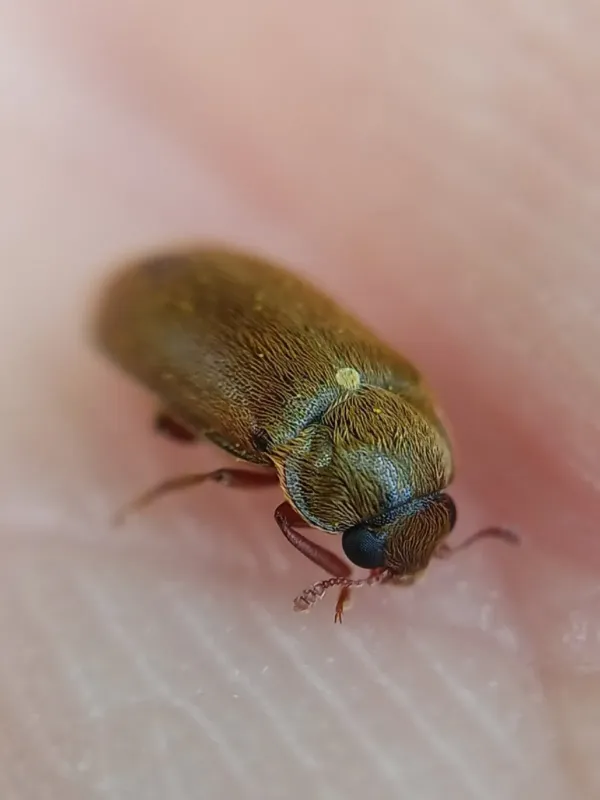
The raspberry beetle Byturus ochraceus is a small insect about 4 millimeters long, with an oval body covered in dense grayish-yellow or brownish hairs. The adult coloration ranges from brown to reddish-brown.
The larvae are whitish or yellowish with darker segments on the dorsal side. A mature larva reaches 6-7 millimeters in length, has developed thoracic legs, and is capable of moving actively across the plant.
Systematically, this species belongs to the order Coleoptera and the family Byturidae. It is a specialized pest whose life cycle is intrinsically linked to the phenology of berry crop development.
Adult beetles overwinter in the soil at a depth of up to 20 centimeters near raspberry bushes. In the spring, as the soil warms to 12-14 degrees Celsius, the insects emerge to the surface and begin active feeding.
Reproduction occurs by laying eggs singly in the flower buds or blossoms. A single female can lay up to 50 eggs per season, posing a significant threat to the future berry harvest.
What it damages
The pest primarily affects raspberries, but can also cause substantial damage to blackberries and, in some cases, stone fruits. The raspberry beetle is considered a major threat to berry cultivation.
In spring, adult beetles damage the buds by eating holes in them. They then move on to young leaves, chewing characteristic irregular holes through the leaf blades.
The greatest damage is caused by the larvae, which develop inside the receptacle and feed on the fruit tissues. This leads to fruit deformation, rotting, and a significant drop in market quality.
Damaged fruits lose their appeal, become unsuitable for fresh consumption, and spoil rapidly during transportation. The presence of larvae inside the berries is the primary reason for market rejection.
In years of massive infestation, the raspberry beetle can destroy more than 50% of the crop, causing serious economic losses for both commercial farms and home gardeners.
When it appears
The emergence of beetles from the soil coincides with the onset of flowering in early raspberry varieties, usually occurring in late May or early June, depending on the climate of the region.
The feeding period of adults on green plant parts lasts for about 2-3 weeks. During this time, the insects are most active in the early morning and evening hours when air temperatures are favorable.
Egg laying continues throughout the entire flowering period of the raspberries. Larval development within the fruit takes about 30-40 days, after which they exit the berries and return to the soil for pupation.
Pupation occurs in summer, and the new generation of adults appears in late July or August. However, they do not emerge to the surface but remain in soil cells until the following spring.
Consequently, the main threat period for the crop is limited to the bud and early flowering phases, when the insects are most vulnerable to control measures.
Signs of infestation
The first sign of the pest is the presence of holes in young raspberry leaves at the beginning of the growing season. Careful inspection of the bushes during this period allows for the detection of the feeding beetles.
Mass infestation is indicated by the appearance of deformed, small, or underdeveloped berries. If a berry is misshapen and turns dark rapidly, a larva is almost certainly present inside.
During harvest, damaged fruits are easy to identify as they often show signs of rot. Inside such a berry, one can find a characteristic pale larva with a dark head upon inspection.
The presence of larval frass within the receptacle is also a direct indicator of raspberry beetle activity. Often, a small exit hole can be spotted on the surface of the affected berry.
A decrease in yield and premature fruit drop in June serve as serious warning signals that the pest population has exceeded the economic threshold.
Control measures
The mechanical control method involves shaking the beetles off the bushes in the morning onto a sheet or umbrella and destroying them. This procedure should be carried out before mass flowering.
Deep cultivation of the soil between rows and under bushes during the pupation period (late summer) helps to destroy the soil cells and reduce the population preparing for winter.
The chemical control method involves the use of systemic or contact insecticides. Treatments must be applied strictly before flowering begins to avoid harming beneficial pollinators, especially honeybees.
Using biological products based on entomopathogenic fungi or bacteria is a safe alternative, allowing for the reduction of the pest population without damaging the environment.
- Regular collection and destruction of damaged berries.
- Mulching the soil to limit beetle emergence in spring.
- Maintaining proper spacing between raspberry rows.
- Using protective netting over the plantings.
Content graph
Connections · Raspberry beetle
Most often together:
Marketplace
Products · 13


Biology
Taxonomy
- Latin name
- Byturus ochraceus
- Order
- Coleoptera (beetles)
- Family
- Byturidae
- EPPO code
- BYTUFU
Community
Discussion
No discussions yet — be the first.