
Wheat streak mosaic
Wheat streak
The causative agent is the Wheat streak mosaic virus (WSMV), which belongs to the Potyviridae family and the Tritimovirus genus. It is a flexuous, filamentous virus particle containing single-stranded RNA.
What the section contains
Wheat streak mosaic
The virus is exclusively transmitted by the wheat curl mite (Aceria tosichella). Mites acquire the virus by feeding on infected host plants and subsequently transmit it while moving to healthy tissue.
WSMV cannot be transmitted through soil, seed, or standard mechanical contact between plants; its survival depends entirely on living hosts and the mite vector.
Primary reservoirs of the virus include volunteer wheat, barley, and various perennial grassy weeds such as wild brome, wild oats, and jointed goatgrass.
The disease spread is directly correlated with the movement of mites, which are wind-dispersed from maturing or senescing plants to newly emerged winter wheat crops.
Wheat streak mosaic primarily affects wheat, but it can also infect other cereal crops like barley, oats, and millet. It is considered one of the most destructive viral diseases of wheat globally.
The damage is caused by the systemic infection of the plant, which severely inhibits nutrient transport, leading to stunted growth, reduced tillering, and poor root development.
Yield losses vary significantly based on the timing of infection; early-season infections can lead to total crop failure, with significant reductions in kernel weight and grain quality.
Affected fields often show irregular patches of stunted, chlorotic plants, which may eventually turn necrotic as the virus continues to multiply within the plant tissues.
In addition to yield loss, the infected crops become more susceptible to environmental stressors, including drought and winter injury, due to an impaired physiological state.
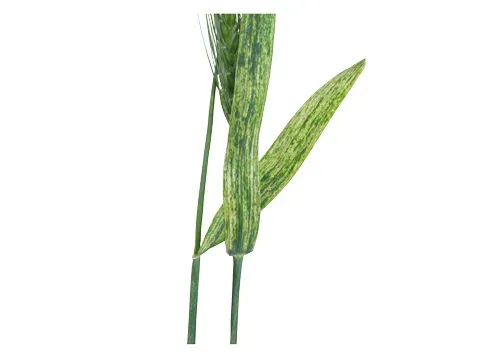
The initial signs of infection appear as light green or yellow streaks and dashes running parallel to the leaf veins, eventually leading to a mosaic-like pattern.
As the disease progresses, the chlorotic streaking becomes more pronounced, and infected leaves may become yellow, curled, or malformed, mimicking nutrient deficiency.
Stunting is a classic diagnostic feature; infected plants appear significantly shorter than healthy ones, often with abnormal bunching or reduced vegetative growth.
Reproductive development is also heavily impacted, resulting in sterile or partially filled heads, poor spike development, and shriveled, low-test-weight grain.
Symptoms are most visible during cool temperatures; however, they can be masked during hot, dry weather, which makes accurate field identification challenging.
The primary control strategy is the elimination of "green bridges"—the removal of volunteer wheat and grassy weeds at least two weeks before planting winter wheat.
Managing planting dates is critical; delaying winter wheat planting can significantly reduce the risk of mite infestation and subsequent viral transmission.
Implementing effective spatial isolation between new winter wheat crops and older, infested fields helps to prevent the movement of viruliferous mites.
Genetic resistance is the most sustainable management tool; planting resistant wheat varieties remains the most effective defense against WSMV epidemics.
- Frequent scouting to monitor mite populations and disease spread.
- Deep tillage to bury host plants and reduce reservoir weed populations.
- Application of cultural practices that promote rapid, uniform crop establishment.