
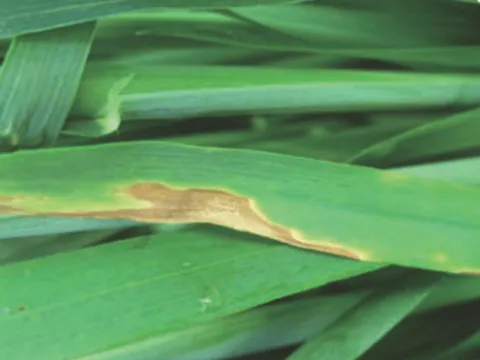
Wheat glume blotch
Septoria nodorum
The causal agent is the fungus Septoria nodorum (teleomorph: Phaeosphaeria nodorum). It belongs to the kingdom Fungi, class Dothideomycetes, and is a major pathogen of wheat and other small grains.
What the section contains
Wheat glume blotch
The fungus survives as mycelium or pycnidia in infected seed, crop debris, and volunteer cereals. It reproduces through pycnidiospores (asexual) and ascospores (sexual) produced in perithecia.
Infection spreads via splash dispersal from rain droplets, which carry spores from the lower leaves to the upper foliage and eventually the wheat head.
This pathogen is highly dependent on environmental moisture. Frequent rainfall and moderate temperatures provide the ideal conditions for spore germination and colonization of host tissues.
Correct diagnosis involves observing the characteristic necrotic spots and the presence of small, dark pycnidia. Molecular methods are sometimes used to distinguish it from other Septoria species.
Septoria nodorum infects various cereal crops, including wheat (winter and spring), barley, and triticale. It causes significant damage in regions with humid climates during the grain-filling stage.
The disease reduces the photosynthetic area by destroying leaf tissue, which directly limits grain filling. This results in shriveled kernels and reduced test weight.
Infection of the glumes (glume blotch) can cause sterility of the florets, leading to empty or partially filled spikes, significantly decreasing overall grain yield.
Economic impact is severe during years with prolonged wet weather, with yield losses frequently ranging from 20% to 50% in susceptible varieties.
Seed quality is also adversely affected, as infected grains have lower germination rates and can carry the pathogen to the next planting season.
Initial symptoms appear early in the season on seedlings. The disease progresses upwards through the canopy as the plant develops, especially under conducive conditions.
The most critical phase occurs from stem elongation to heading. Rain-driven dispersal moves the pathogen onto the upper leaves and ears during the grain-filling period.
The pathogen thrives in temperatures between 15°C and 25°C. High humidity or leaf wetness duration is essential for the infection process to occur successfully.
While development slows down in dry weather, the fungus persists in a dormant state and reactivates rapidly when moisture levels rise again due to dew or rain.
In the autumn, the fungus continues to infect winter wheat, providing a source of primary inoculum that carries the pathogen through the winter months.
The first symptoms are small, water-soaked spots that expand into irregular, brownish lesions, often surrounded by a chlorotic (yellow) halo.
Dark, pinhead-sized pycnidia appear within the centers of these necrotic lesions. This is the most reliable visual characteristic for identifying the disease in the field.
Stem nodes may become discolored and brown, leading to stem weakness and potential lodging of the crop before harvest.
Glume blotch symptoms appear on the ears as grayish-brown to dark brown blotches. In moist conditions, the ears may look dirty or covered in dark fruiting bodies.
- Small, irregular brown leaf lesions with chlorotic halos.
- Presence of visible black pycnidia in lesion centers.
- Browning and decay of stem nodes.
- Discoloration of glumes and florets.
- General senescence of leaves leading to yield loss.
Integrated disease management includes the use of resistant or tolerant wheat varieties and crop rotation to prevent the buildup of soil-borne inoculum.
Cultural practices such as deep tillage to bury crop residues help reduce primary inoculum. Controlling volunteer wheat is also a critical step in breaking the disease cycle.
Seed treatment with systemic fungicides is essential to provide early-season protection and prevent the systemic spread of the pathogen from the seed.
Foliar fungicide applications are necessary during the growing season, particularly targeting the flag leaf and the ear emergence stage to protect yield potential.
Effective chemical control involves using triazoles, strobilurins, or carboxamides. It is recommended to rotate chemical classes to avoid the development of fungicide resistance.