
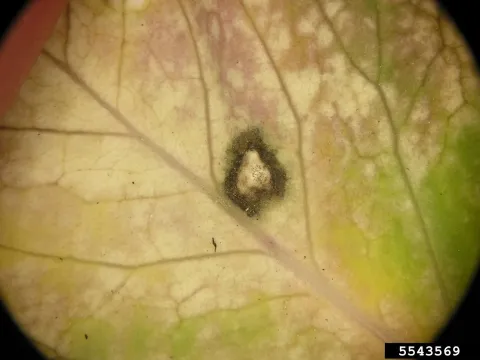
White leaf spot of brassicas
Pseudocercosporella capsellae
The causative agent of this disease is the fungus Pseudocercosporella capsellae, belonging to the division Ascomycota. It is a specialized pathogen that primarily targets plants within the Brassicaceae family, causing significant economic losses globally.
What the section contains
White leaf spot of brassicas
The pathogen survives primarily in soil and on infested crop debris, where it persists through winter as mycelium or conidia. The infection process is triggered when spores land on susceptible leaf surfaces under favorable moisture conditions.
Spore dissemination is predominantly mediated by rain splash and wind, which transport conidia to healthy tissues. The infection usually initiates in the lower canopy where humidity levels remain consistently high throughout the season.
Structurally, the fungus produces conidiophores in clusters, which give rise to numerous conidia. These spores are responsible for the secondary cycles of infection that can occur rapidly during rainy periods.
Detection in the field can be challenging due to symptoms often overlapping with other fungal diseases, necessitating microscopic examination to confirm the presence of Pseudocercosporella spores.
The disease affects a wide range of economically important crops, including oilseed rape (canola), mustard, cabbage, and turnip. Wild Brassicaceae species often act as alternative hosts, maintaining the inoculum during periods when primary crops are not present.
Pathogen attack occurs on all aerial parts of the plant, including leaves, stems, and siliques. This systemic infection severely disrupts plant growth and impairs normal physiological development.
Leaf infection causes extensive damage to the photosynthetic area, which leads to reduced biomass accumulation and the premature senescence of foliage, weakening the overall plant vitality.
When the pathogen infects stems and siliques, it interferes with nutrient translocation, resulting in shriveled seeds, lower oil content, and a significant decrease in final grain yield and quality.
Under severe epidemic conditions, yield losses can be substantial, often exceeding 20-30%, making the management of this pathogen a priority for commercial Brassica production.
The disease thrives in cool, wet environments, with optimal infection occurring at temperatures between 15°C and 20°C. However, the fungus remains active across a broader range of temperatures.
Autumn remains a critical period for winter crops, while spring provides ideal conditions for rapid disease spread as frequent rainfall events facilitate the movement of spores across the field.
Dense crop stands create a microclimate that promotes high humidity within the canopy, accelerating the development of the fungus and increasing the speed of the infection cycle.
Short crop rotation cycles, where Brassica crops are grown too frequently on the same land, lead to the accumulation of high levels of inoculum, significantly raising the risk of early-season infection.
Drier periods can temporarily halt disease progression, yet the fungus maintains viability and can resume rapid growth immediately upon the arrival of further moisture.
Initial symptoms are characterized by small, chlorotic spots that eventually develop into white or grayish lesions. This distinctive appearance is the reason for the common name, white leaf spot.
As lesions mature, they may develop darker margins, and the centers of the spots can become necrotic and brittle, often cracking or dropping out to create a shot-hole effect on the leaf.
Under humid conditions, a fine, pale fungal growth consisting of massed spores may be visible on the undersides of the leaves, indicating active sporulation.
- Circular to irregular white or gray spots on leaves.
- Yellowing and premature abscission of lower leaves.
- Lesions on stems causing tissue damage and weakness.
- Reduced pod filling and distorted silique development.
- Premature pod ripening and shattering during harvest.
In cases of heavy infection, individual lesions coalesce, covering large parts of the leaf surface, which leads to total leaf blight and stunted plant growth.
The primary control strategy involves sound agronomic practices, such as a minimum 3-4 year crop rotation to ensure the breakdown of infected crop residues before the next susceptible crop is planted.
Deep tillage following harvest is effective at burying crop debris, which accelerates decomposition and reduces the amount of primary inoculum available for the next growing season.
Effective weed management, focusing on the removal of wild Brassicaceae hosts from field margins, is essential to break the infection cycle and reduce the initial spore load.
Fungicide applications are recommended during periods of high infection risk, particularly when weather forecasts predict extended cool and rainy spells during the vegetative stage.
Utilizing resistant or tolerant cultivars is the most sustainable management tool, as it reduces dependence on chemical interventions and helps maintain consistent yields despite environmental pressure.