
White leaf spot of brassicas
Pseudocercosporella capsellae
Description
How to identify
The pathogen Pseudocercosporella capsellae is an ascomycete fungus that causes severe leaf spotting diseases primarily on Brassicaceae family crops.
It reproduces through conidia, which are long, slender, multi-celled spores that facilitate the spread of the disease within and between fields.
The fungus is capable of surviving for long periods on infected crop residues in the soil, making it a persistent challenge in intensive agricultural systems.
Classification-wise, it belongs to the order Mycosphaerellales, and its presence is confirmed through the observation of conidiophores and characteristic spore shapes under a microscope.
Airborne dispersal of spores is the primary mode of transmission, although rain splash also plays a significant role in moving the pathogen to lower leaves.
What it damages
Oilseed rape (canola) is the most economically significant host, where the disease causes premature leaf senescence and yield reduction.
Other affected crops include cabbage, cauliflower, broccoli, radish, and various mustard varieties, which suffer from reduced photosynthetic efficiency.
The severity of damage is linked to the timing of infection; early outbreaks in the season are significantly more detrimental to final yield than late-season infections.
Severe infestations result in poor pod fill and shriveled seeds, directly impacting the quality and weight of the harvested product.
Beyond crop loss, the pathogen weakens the overall plant vigor, increasing susceptibility to other pests and adverse winter conditions.
When it appears
The development of the fungus is highly dependent on environmental conditions, specifically moisture and temperature ranges.
Infection occurs most readily during cool, wet spring weather, which supports the germination of conidia on the leaf surface.
Secondary cycles of the disease are frequent throughout the summer if environmental conditions remain conducive, particularly in humid regions.
High humidity and moderate temperatures between 15°C and 22°C are considered optimal for the rapid spread of white leaf spot.
As the season progresses and temperatures rise or conditions become drier, the disease progression typically slows down, though inoculum remains in debris.
Signs of infestation
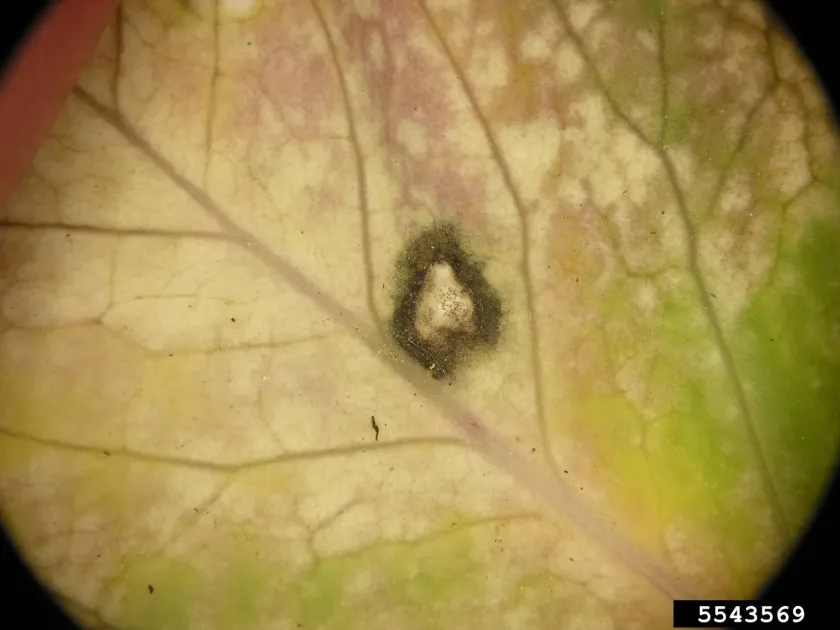
The disease first manifests as small, circular, or irregular spots on the cotyledons and the lower leaves of the host plants.
As the lesions expand, they develop a white or grayish center, often surrounded by a dark brown or purplish margin.
In humid conditions, a fine, grayish fungal growth can sometimes be seen on the underside of the leaf, corresponding to the site of the lesions.
Over time, the necrotic tissue in the center of the spots may tear, leading to a "shot-hole" effect on the leaves of the infected plants.
Eventually, the spots coalesce, leading to extensive yellowing and necrosis of the leaf blades, causing early leaf drop in the lower plant canopy.
Control measures
Effective management begins with strict crop rotation, ensuring that susceptible Brassicaceae crops are not grown on the same field more than once every three years.
Deep plowing of crop residues is essential to bury infected material and accelerate the breakdown of the pathogen's primary inoculum.
Integrated weed management must be practiced to eliminate volunteer brassicas and wild mustard species that serve as alternate hosts.
Fungicide application may be required in high-risk areas, particularly during the early vegetative growth stages of the crop.
- Utilizing certified, disease-free seed lots.
- Selecting resistant cultivars adapted to the region.
- Ensuring proper spacing to improve air circulation within the canopy.
Discussion
No discussions yet — be the first.