
Wheat streak mosaic
Wheat mosaic
Wheat streak mosaic is caused by the Wheat streak mosaic virus (WSMV). It belongs to the Potyviridae family and the Tritimovirus genus, characterized by its thread-like viral particles.
What the section contains
Wheat streak mosaic
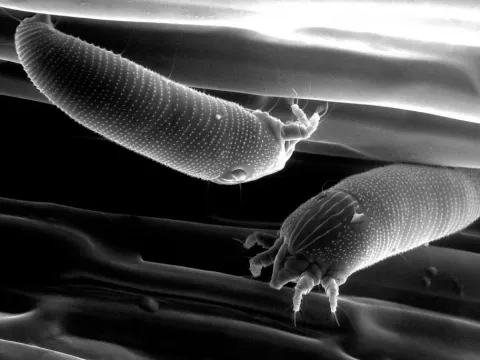
The virus is an obligate parasite transmitted by the wheat curl mite (Aceria tosichella). It does not spread through seeds but relies on the movement of mites between host plants.
The virus survives in volunteer wheat, perennial grasses, and emerging winter wheat crops, which act as a continuous reservoir for the pathogen throughout the year.
Optimal environmental conditions for the virus include mild temperatures between 20 and 25 degrees Celsius, which also align with the peak activity of the mite vectors.
Once inside the plant, the virus disrupts the vascular tissue, severely impairing the host's ability to photosynthesize and effectively transport nutrients.
The virus primarily affects winter and spring wheat, but it can also infect maize, barley, millet, and various grassy weeds that serve as alternative hosts.
Infection leads to significant yield losses, often manifesting as reduced grain weight, poor grain filling, and decreased total biomass of the crop.
Plants infected at an early growth stage often exhibit stunted growth, excessive tillering, and an overall frail appearance that makes them prone to lodging.
Reproductive success is severely hampered, with the virus causing pollen sterility, which results in empty or shriveled heads with very poor kernel quality.
Under favorable conditions for the mite, severe outbreaks can cause losses ranging from 30 to over 70 percent, threatening the economic viability of wheat fields.
The primary infection period occurs during the autumn, as winter wheat seedlings emerge and become vulnerable to migrating mites carrying the virus.
Springtime conditions often trigger a secondary wave of infection as temperatures rise, facilitating the rapid reproduction of the wheat curl mite on young tissues.
Extended, warm autumns are particularly dangerous, as they allow for a longer window of mite activity, increasing the viral load before the winter dormancy.
Climate factors that promote early spring development also increase the risk of the virus spreading rapidly throughout the field from isolated initial infection spots.
The disease cycle is most active during the vegetative growth phases, while the transmission rates tend to decline as the plants approach the maturity stage.
The earliest symptoms are visible as yellowish, chlorotic streaks or mosaic patterns developing parallel to the leaf veins, giving the foliage a mottled appearance.
Stunting is a key diagnostic feature; infected plants appear significantly shorter and less vigorous than healthy counterparts in the same field.
Leaves may exhibit distortion or curling, and in advanced stages, they may show premature necrosis, which can be confused with nutrient deficiencies or environmental stress.
- Discontinuous yellow streaks along the leaf veins.
- Excessive tillering accompanied by weak stem development.
- Malformed or partially sterile wheat heads.
- General chlorosis or pale green discoloration of the canopy.
Symptoms are usually clustered in patches within the field, reflecting the localized initial colonization by mites carried by wind currents.
The most critical control strategy is the elimination of the "green bridge" by removing volunteer wheat and weeds at least two weeks before planting winter wheat.
Adjusting planting dates to avoid the peak migration period of the wheat curl mite can significantly reduce the risk of early-season infection.
Selecting resistant or tolerant wheat varieties is the most sustainable and effective way to manage the disease and mitigate losses across large-scale operations.
Applying seed treatments with insecticidal and acaricidal properties provides essential protection for seedlings during the most vulnerable stage of development.
Maintaining spatial isolation between wheat fields and maize or grassy areas reduces the probability of mites migrating to the wheat crop from reservoir hosts.