
Phomopsis seed decay
Phomopsis longicolla
The causal agent of Phomopsis seed decay is the fungus Phomopsis longicolla (often referred to as Diaporthe longicolla), a member of the Ascomycota phylum. It is a significant phytopathogen that causes both stem damage and seed degradation in soybean crops.
What the section contains
Phomopsis seed decay
The fungus produces pycnidia, which are small black fruiting bodies that contain conidia. These spores are spread through rain splashes and wind, initiating infection on stems and eventually reaching the developing seed pods.
Phomopsis is a persistent pathogen capable of surviving in infested crop residues, within the soil, and inside infected seeds for several years. This makes it a difficult pathogen to eradicate once it is established in a field.
Diagnostic identification typically involves observing the characteristic rows of pycnidia on the lower stems of mature plants. Laboratory analysis via blotter tests or nutrient media incubation confirms the presence of the fungus by its distinct mycelial growth.
Understanding the life cycle is crucial because the pathogen can remain latent in the plant tissue for long periods before environmental conditions trigger rapid colonization and symptom expression.
Soybean is the primary host for Phomopsis longicolla, although it can occasionally infect other legumes. The disease causes significant yield losses, primarily through reduced seed quality and lower grain weight.
Stem infection disrupts the transport of water and nutrients within the plant, leading to stunted growth and premature death. This process, often called "top dieback," prevents the pods from filling properly, resulting in shriveled or underdeveloped seeds.
Seed damage is the most critical economic factor. Infected seeds become discolored, cracked, and covered in white mold, making them unsuitable for industrial processing or market sales. This reduces the value of the entire harvest.
Germination rates and seedling vigor are severely compromised by the seed-borne nature of the fungus, leading to poor stands in the subsequent growing season if untreated seeds are planted.
The pathogen is particularly destructive in regions with high humidity during the pod-filling stages, as the fungus aggressively colonizes the pods and penetrates the seeds under these conditions.
The development of Phomopsis occurs throughout the growing season, but symptoms become most evident as the crop approaches maturity, specifically during the R5 to R7 growth stages.
Infection is favored by warm, humid weather. Spores produced in pycnidia on old crop residues are splashed onto healthy stems by rainfall, beginning the primary cycle of infection during early development.
As the season progresses and the plant begins to senesce, the fungus colonizes the stems and eventually moves into the pods. High moisture levels in late summer are highly conducive to a disease outbreak.
The pathogen completes its cycle as the seeds mature. The presence of the fungus inside the seed serves as the primary mechanism for the long-distance spread of the disease to new areas via international and local seed trade.
Even after harvest, if the seeds are stored under warm and humid conditions, the fungus can continue to grow, leading to the rapid deterioration of seed quality during the storage period.
The first sign of the disease is the appearance of small, brown, irregular spots on the stems near the nodes. These spots expand and may merge to form large, darkened lesions.
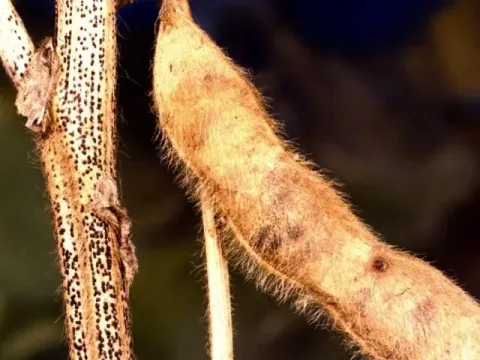
A definitive diagnostic sign is the formation of rows of small, black pycnidia on the surface of the infected stems. This gives the stem a rough, sandpaper-like texture when touched.
Leaves may show yellowing and wilting, as the systemic infection impairs the plant's ability to maintain its vascular functions. In severe cases, premature defoliation occurs.
Infected pods appear grey or brown and are often covered in small, black pimple-like structures. The seeds inside are frequently small, shriveled, and may exhibit white mold growth.
In the field, infected plants stand out due to their darkened stems and the presence of scattered areas of premature dying, which contrast sharply with the healthy, green canopy.
Using high-quality, disease-free seed is the most effective way to prevent the introduction of Phomopsis longicolla into new fields, as it is primarily a seed-borne pathogen.
Effective seed treatment with systemic fungicides is essential to protect germinating seeds and young seedlings from early-season soil-borne or seed-borne infection.
Crop rotation remains a key cultural practice; planting non-host crops for at least two to three years helps reduce the fungal inoculum present in the field debris.
Tillage practices that incorporate crop residues into the soil promote the breakdown of the debris, which helps reduce the survival of the fungus and limits its spread for the next season.
- Selecting resistant or tolerant soybean varieties.
- Applying fungicides during the R3-R5 stages to protect pods.
- Managing weeds that may act as alternative hosts.
- Ensuring proper post-harvest drying and storage conditions.