
Phoradendron
Phoradendron
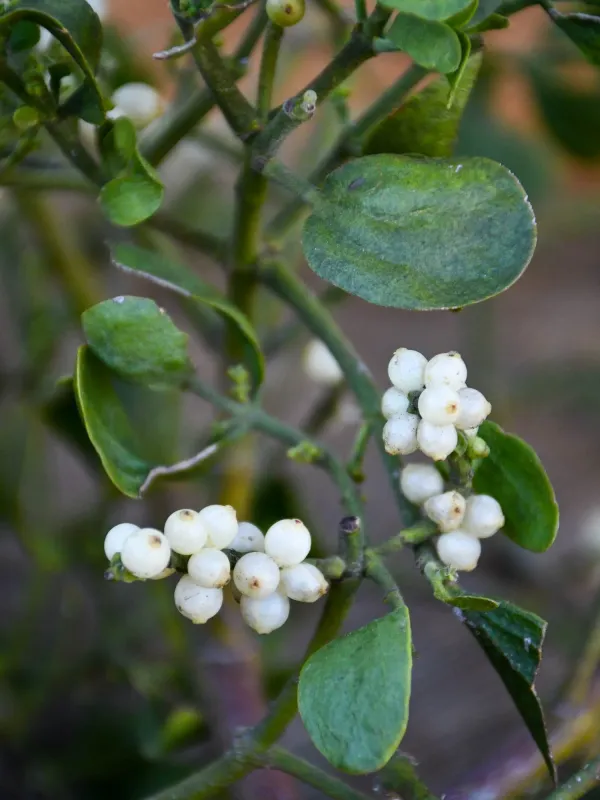
Description
How to identify
Phoradendron is a genus of evergreen hemiparasitic plants in the Santalaceae family. These plants are commonly known as American mistletoe and are characterized by their ability to thrive on the branches of various host trees, extracting water and mineral nutrients from them.
Unlike holoparasites, Phoradendron species possess chlorophyll and can carry out photosynthesis. However, they rely entirely on their host for physical support and the uptake of essential xylem sap, making their survival dependent on the tree's health.
The genus includes numerous species, most notably Phoradendron leucarpum. They are typically observed as dense, leathery-leafed bushes with characteristic white or yellowish berries that serve as a primary food source for birds, facilitating seed dispersal.
The plant attaches to the host via specialized root-like structures called haustoria. These structures penetrate the bark and connect directly into the host tree's vascular system, allowing the parasite to siphon off water and dissolved nutrients continuously.
Phoradendron is widely distributed across the Americas, adapting to diverse ecosystems ranging from lush river valleys to arid scrublands. Their ability to survive in varying moisture conditions makes them a persistent threat to many indigenous and ornamental tree species.
What it damages
Phoradendron attacks a wide range of deciduous and evergreen trees, including oaks, elms, maples, and fruit trees. By diverting vital resources, the parasite weakens the host tree, leading to reduced growth rates and poor overall vigor.
Infection often results in structural stress to the tree's vascular system. As the parasite draws water, especially during hot and dry seasons, the branches beyond the point of infection become stressed, which can lead to localized wilting or branch dieback.
The presence of Phoradendron often triggers the development of witch's brooms, where the tree produces dense clusters of stunted twigs in response to the parasitic attack. These deformations disrupt normal sap flow and weaken the branch's structural integrity.
Trees heavily infested with mistletoe show significantly reduced immunity, making them highly susceptible to secondary attacks by wood-boring insects and various fungal pathogens that exploit the already weakened tissues of the host.
In urban landscapes and orchards, the economic impact is significant. It decreases property value, ruins the aesthetic appeal of ornamental trees, and necessitates the removal of trees that become too brittle or damaged to be safely maintained.
Signs of infestation
The most recognizable sign is the presence of green, bushy clumps within the canopy of deciduous trees during winter. When the host tree sheds its leaves, the evergreen Phoradendron becomes clearly visible as a dense mass on the bare branches.
Premature leaf drop and yellowing of foliage on specific branches are strong indicators of infection. If a section of the tree shows signs of distress while the rest of the canopy remains healthy, it often points to a concentrated parasitic load on that limb.
Swelling or tumor-like growths on the bark at the attachment site are common symptoms. This occurs as the tree attempts to create a defensive barrier or callus tissue around the invading haustoria, causing permanent deformity to the branch.
The accumulation of bird droppings on certain limbs is a frequent early sign. Birds feed on the berries and deposit the sticky seeds onto the branches, where they quickly germinate and begin the process of boring into the bark.
Advanced infestations are characterized by severe canopy thinning, dead twigs, and dry, brittle wood. In extreme cases, limbs may break under their own weight during storms, revealing the extent of internal damage caused by the parasite.
Control measures
Pruning is the primary method of control for Phoradendron. To be effective, the infected branch must be cut at least 15 to 20 centimeters below the point where the parasite is attached, ensuring that the entire haustorial system is removed from the wood.
Maintaining tree vigor through consistent irrigation and appropriate fertilization helps the host tree remain resilient. Healthy, well-nourished trees are better equipped to withstand and isolate minor infections compared to stressed or neglected specimens.
Chemical control via trunk injections of specific growth regulators is sometimes used by arborists. This method targets the parasite’s development and can be useful in managing large trees where pruning is physically impossible or hazardous.
Biological management focuses on preventing the spread by removing the berry-bearing parts of the plant before they reach full maturity. This limits the availability of seeds for local bird populations, thereby reducing the rate of new infestations.
In cases of severe infestation, removal of the entire tree may be necessary to protect the surrounding landscape. Clearing heavily infected trees prevents them from acting as a source of seeds, effectively breaking the cycle of infection for the entire area.
Causes diseases · 1
Discussion
No discussions yet — be the first.