
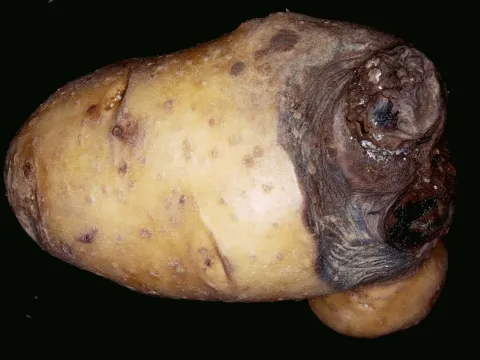
Phomopsis stem canker
Boeremia exigua
The pathogen Boeremia exigua (formerly classified within the genus Phoma) is a ubiquitous coelomycetous fungus belonging to the Pleosporales order.
What the section contains
Phomopsis stem canker
This fungal agent is characterized by the production of pycnidia, which are asexual fruiting bodies that contain large numbers of conidia for dissemination.
Boeremia exigua displays significant genetic diversity, allowing it to adapt to various environmental conditions and hosts, maintaining long-term survival in the soil.
The life cycle of this pathogen involves both sexual (teleomorph) and asexual (anamorph) stages, though the asexual stage is the primary driver of rapid infection.
Precise identification is achieved through microscopic observation of the pycnidia's morphology and molecular diagnostic techniques to differentiate it from other Phoma-like fungi.
Boeremia exigua is a broad-host range pathogen that severely affects various agricultural sectors, including pulse crops, vegetables, and technical oilseeds.
The fungus causes severe damage by attacking the roots, stems, and leaves, often leading to systemic necrosis and the inhibition of water and nutrient transport.
On tuberous and root crops, the pathogen induces a characteristic dry rot that renders produce unmarketable and susceptible to subsequent opportunistic decay.
Stem cankers caused by this fungus can significantly weaken the structural integrity of crops, leading to lodging and reduced efficacy during mechanical harvesting.
In cases of severe infestation, yield losses can be substantial, as the pathogen restricts photosynthesis and overall plant physiological function during the active growth phase.
Infection cycles typically begin in early spring, when spores are released from overwintered plant debris or infected soil particles in response to warmer weather.
High humidity and moderate temperatures between 15°C and 25°C are the primary environmental drivers for the rapid multiplication and germination of fungal conidia.
During the growing season, the pathogen is dispersed across fields by splashing rain, wind-blown aerosols, and movement of contaminated farm equipment.
By late autumn, the fungus retreats into a survival state, persisting as dormant mycelium or thick-walled chlamydospores until the next conducive season arrives.
Persistent moisture and poor canopy drainage act as catalysts for flare-ups, allowing the disease to spread rapidly through dense crop stands.
The initial symptoms present as small, irregular brown spots on stems and leaves, which gradually enlarge to form concentric lesions with necrotic centers.
As the infection progresses, stem lesions often sink into the tissue, creating visible cankers that weaken the stalk and lead to tissue collapse.
The appearance of numerous pin-head-sized black dots, which are the pycnidia, within the necrotic lesions is a definitive sign of Boeremia exigua activity.
Affected plants often show chlorosis and wilting during periods of peak water demand because the colonized stem tissue can no longer support vascular function.
- Concentric brown lesions on stems and leaves.
- Sunk-in stem cankers that cause lodging.
- Black pycnidia dots scattered on necrotic tissue.
- General plant wilting and root necrosis.
Implementing a rigorous crop rotation cycle that avoids susceptible host crops for three or more years is the most effective cultural control strategy.
Sanitation practices, including the removal and deep incorporation of infected crop residues, significantly lower the primary inoculum pressure for the following season.
Seed treatment using high-efficacy fungicides is essential to prevent the pathogen from being introduced into clean fields during the planting phase.
Foliar application of fungicides, specifically those containing triazoles or strobilurins, should be timed based on environmental alerts to suppress pathogen expansion.
Post-harvest storage management, maintaining low temperatures and dry conditions, is critical to preventing the spread of dry rot in bulk-stored crops.