
Eutypa dieback
Eutypa lata
Eutypa dieback is a serious fungal disease of grapevines caused by the pathogen Eutypa lata, a member of the Diatrypaceae family within the Ascomycota division.
What the section contains
Eutypa dieback
This fungus is a woody plant pathogen that colonizes the vascular tissues, specifically the xylem, leading to chronic wood decay in perennial parts of the vine.
The fungus is known for its slow development, often remaining latent in the wood for several years before visible symptoms appear on the foliage.
Dissemination occurs primarily via ascospores released from dead wood surfaces, which are carried by wind and rain into fresh pruning wounds.
Once established, the mycelium grows deeper into the vine's structure, causing irreversible damage to the conductive vessels required for nutrient transport.
The disease affects various woody plants, including grapes (Vitis vinifera), apricots, and other fruit trees, causing significant agricultural losses worldwide.
Damage is localized in the trunks and cordons, where the fungus causes wood necrosis, effectively girdling the vascular system of the vine.
Affected vines show decreased vigor, leading to poor fruit set and reduced berry quality, which eventually renders the vine unproductive.
Over time, the cumulative effect of the disease leads to a steady decline of the entire plant, which can result in the death of the cordon or the entire vine.
The economic impact is high because the disease necessitates the removal and replacement of mature, high-yielding vines in established vineyards.
The most recognizable symptoms appear in the spring when infected shoots emerge with shortened internodes and stunted growth.
Leaves on infected shoots are typically smaller, chlorotic, and exhibit cupping or marginal necrosis caused by the systemic translocation of fungal toxins.
In mid-summer, infected clusters often wither and drop, or they remain small, misshapen, and poorly developed compared to healthy ones.
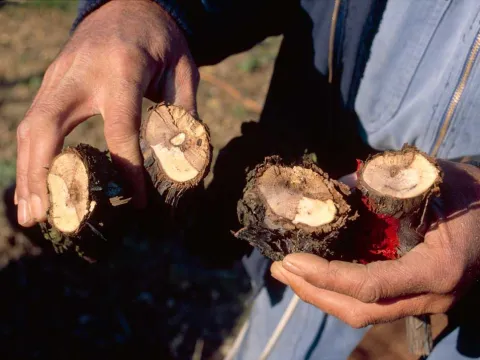
A cross-section of an infected trunk or cordon reveals a distinct wedge-shaped dark brown or black necrosis surrounded by healthy wood.
As the disease progresses, the surface of dead bark may reveal small, black, pin-head-sized fruiting bodies known as perithecia.
Management focuses on prevention, primarily by protecting fresh pruning wounds from spore inoculation during the dormant season.
Practicing late-winter pruning or pruning in dry weather significantly reduces the risk of spore infection, as wet conditions favor spore release.
Applying protective fungicides or sealant pastes to large pruning wounds is a critical cultural practice to inhibit fungal colonization.
Regular sanitation, including the removal and destruction of dead wood and heavily infected vines, is essential to lower the overall inoculum pressure.
- Sterilizing pruning tools with alcohol to prevent cross-contamination between vines.
- Executing "remedial surgery" by cutting back infected cordons to healthy wood.
- Monitoring the vineyard in spring to identify and mark infected vines for removal.
- Prioritizing the health of young vines to build long-term structural integrity.