
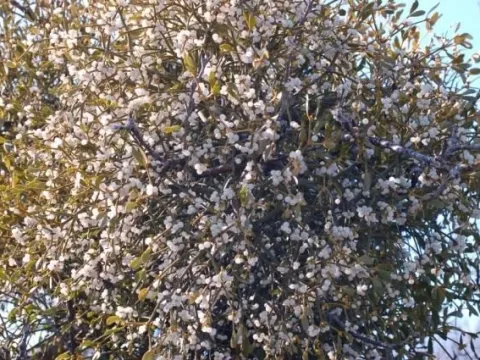
European mistletoe
Viscum album
European mistletoe (Viscum album) is a hemiparasitic shrub that belongs to the Santalaceae family. It is a perennial evergreen plant that thrives on the branches of various host trees.
What the section contains
European mistletoe
The plant grows as a dense, spherical bush, typically reaching sizes between 20 cm and 1 meter in diameter. Its stems are dichotomously branched and have a distinct yellowish-green color.
Leaves are leathery, oblong, and arranged in opposite pairs. Because they contain chlorophyll, they can perform photosynthesis, though the plant remains dependent on the host for water and minerals.
Mistletoe attaches to the host via a structure called a haustorium. This organ penetrates the bark and reaches the xylem, effectively tapping into the tree's internal water transport system.
Reproduction occurs via sticky seeds contained in white, fleshy berries. These seeds are spread primarily by birds, which feed on the berries and deposit the seeds onto other branches.
This parasite affects a wide range of deciduous trees, including popular species like linden, poplar, birch, and various orchard trees such as apple and pear.
Mistletoe drains essential resources from the host tree, leading to gradual exhaustion. By intercepting water and nutrients, it hinders the tree's normal growth and metabolic processes.
The area of infection often shows physical deformation, such as swelling of the bark and abnormal thickening of the branch, which weakens the tree's structural integrity.
Heavy infestations result in a decline of the tree's vigor. Symptoms include reduced foliage density, stunted shoot growth, and a significant drop in fruit production.
Severe and prolonged infestations can ultimately lead to dieback of the crown, rendering the tree vulnerable to other secondary pests and pathogens.
As a perennial plant, mistletoe maintains a year-round presence on its host. Its biological activity, however, is synchronized with the seasons of the host tree.
The germination phase typically starts in the spring, once the sticky seeds have successfully adhered to a fresh, thin layer of bark on a host branch.
During the summer months, the mistletoe grows its vegetative biomass, actively synthesizing energy while simultaneously extracting resources from the tree.
Winter is the most critical time for detection, as the evergreen mistletoe remains fully visible while the deciduous host trees shed their foliage.
Late winter and early spring represent the period of fruit maturation and seed dispersal, during which the parasite utilizes avian vectors to colonize new locations.
The most reliable sign of mistletoe infestation is the presence of rounded, evergreen bushes nestled within the canopy of the tree.
Swelling or woody growths at the point of attachment indicate that the haustorial system has firmly established itself within the branch's vascular tissue.
Yellowing leaves or premature defoliation of the host tree branch, particularly near the site of the mistletoe, indicate a severe restriction of nutrient flow.
Branch fragility is a common symptom; infected limbs are prone to breakage during high winds or heavy snow due to the weakening of the wood at the attachment site.
- Visible spherical clumps in the canopy throughout winter.
- Deformed, swollen, or cracked bark around the parasite attachment.
- Stunted growth of the infected host branch.
- Dieback of the tree crown beyond the point of infection.
Mechanical removal is the primary and most effective method of control. Infected branches must be pruned at least 15–20 cm below the site of mistletoe attachment.
It is vital to dispose of the pruned material by burning, as berries left on discarded branches can still mature and release seeds into the environment.
Regular tree inspection is necessary, especially in urban areas and orchards, to detect and remove the parasites before they reach the fruit-bearing stage.
In cases of extreme infestation where the parasite has overtaken the majority of the crown, tree removal may be necessary to protect the health of surrounding trees.
Currently, there are no chemical systemic treatments available that can selectively kill mistletoe without causing severe harm to the host tree.