
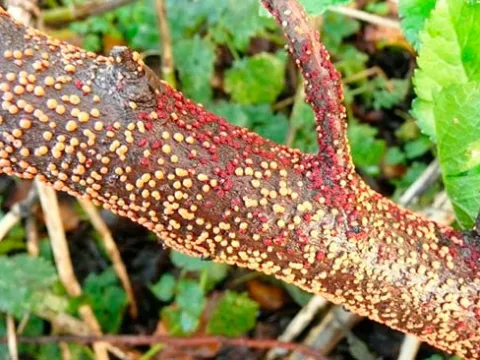
European fruit tree canker
Nectria galligena
Nectria galligena is an ascomycete fungus that acts as the primary causal agent of European fruit tree canker. It belongs to the family Nectriaceae and is a serious pathogen affecting deciduous trees globally.
What the section contains
European fruit tree canker
The fungus propagates through two types of spores: conidia, which are produced in moist, white pustules, and ascospores, formed in small, dark-red, spherical fruiting bodies known as perithecia.
The pathogen primarily infects trees through natural openings, such as leaf scars, fruit stalks, or mechanical injuries caused by pruning, insects, or frost damage. Once inside, the mycelium spreads through the bark and cambium layers.
Identification is based on the visual appearance of cankers and the presence of the fungus's fruiting structures. Advanced diagnosis involves culturing samples on media or using microscopic examination of spores collected from the surface.
As a biotroph-necrotroph, the fungus is highly adapted to the host, slowly causing tissue necrosis. Its ability to remain active for years within the wood makes it a persistent threat to commercial and ornamental plantings.
Apple and pear trees are the most susceptible hosts, but the disease also attacks a variety of other trees, including hawthorn, hazel, oak, and ash. This wide host range facilitates the survival and spread of the pathogen in rural landscapes.
The disease affects limbs, branches, and the main trunk. On young twigs, it causes dieback and breakage, whereas on mature wood, it forms distinct, deep, and open cankers that can eventually girdle the branch.
Fruit can be infected, showing eye-shaped rot spots that often develop in the orchard or during post-harvest storage. Infected fruits turn mushy, brown, and eventually shrivel, making them completely unmarketable.
The economic impact of this canker is significant, as it leads to reduced yields, increased expenditure on sanitation, and the potential loss of entire trees that have been structurally weakened by the infection.
Structural damage often forces growers to implement drastic pruning or tree removal. A girdled trunk stops the flow of nutrients, leading to the death of all parts of the tree located above the infection site.
Infection is most intense during wet and humid conditions, typically during the autumn and spring. Rain splashes are the main mechanism for the dispersal of spores from the fruiting bodies to healthy tissues.
Summer heat and dryness inhibit fungal growth, yet the fungus persists within the living wood. The temperature range for optimal mycelial development is between 5 and 15 degrees Celsius, making temperate climates highly favorable.
The fungus overwinters in established cankers as dormant mycelium or as fruiting bodies. As soon as temperatures rise in late winter or early spring, the fungus resumes sporulation, posing a constant risk to new growth.
Pruning periods are critical, as fresh cuts are highly susceptible to infection if weather conditions are damp. This necessitates the adoption of strict sanitary protocols during dormant season pruning sessions.
Seasonal patterns of humidity dictate the infection frequency. High rainfall during leaf fall increases the number of entry points, significantly raising the risk of new cankers developing throughout the upcoming season.
The most recognizable sign is a sunken, open canker surrounded by concentric callus ridges. These ridges represent the tree’s failed attempts to seal off the infection site as the fungus slowly expands each year.
Younger twigs often appear shriveled and may show a distinct reddish-brown discoloration. In humid weather, small white, cushion-like sporulation structures may appear on the surface of the infected bark.
At later stages, the wood beneath the bark becomes necrotic and turns black, eventually causing the bark to peel away. The inner wood remains soft and decayed, serving as a reservoir for further fungal activity.
Leaves on infected branches may wilt or turn yellow during summer stress. Because the vascular system is compromised, these branches show stunted growth and poor fruit set compared to healthy parts of the canopy.
Fruit infection symptoms appear as dark, sunken spots, often centered around the calyx or stalk. As the rot progresses, these areas may become covered in white fungal mycelium, producing a mass of conidia.
- Strict sanitation involving the pruning of all infected wood with a buffer zone of healthy tissue.
- Sterilizing pruning tools after every cut to prevent cross-contamination between trees.
- Applying protective wound paints or fungicides to pruning cuts to seal entry points.
- Using copper-based sprays in the autumn and early spring to create a protective barrier against spores.
- Maintaining optimal orchard vigor through balanced fertilization and stress prevention to improve tree defenses.
Effective control requires a proactive approach. Since deep trunk cankers are difficult to cure, preventing initial infection by protecting bark from frost cracks and insect wounds remains the most successful management strategy.
Integrated Pest Management (IPM) is essential. Because insects and pests create pathways for fungal spores, controlling these vectors is a key step in preventing the spread of European fruit tree canker.
If a tree is severely infected, total removal is recommended. Leaving dead or severely cankered trees in the orchard provides a continuous source of spores, potentially leading to an epidemic across the entire plot.
Proper canopy management, such as thinning to improve airflow and light penetration, reduces local humidity and discourages the conditions required for spore germination and colonization on the branches.