
Colletotrichum musae
Colletotrichum musae
Colletotrichum musae is a filamentous fungus belonging to the kingdom Fungi, phylum Ascomycota, and the genus Colletotrichum. This phytopathogen is a highly specialized parasite that primarily attacks plants within the Musaceae family, with bananas being the main commercial host.
What the section contains
Colletotrichum musae
The microscopic morphology of the fungus consists of hyaline, septate hyphae that develop into specialized fruiting structures known as acervuli. Under high humidity, these structures produce masses of conidia, which typically appear as pinkish or orange spore masses on the surface of infected tissues.
The life cycle of the pathogen encompasses both a parasitic phase on living host tissue and a saprotrophic phase on decaying plant debris. A notable biological characteristic is its ability to establish latent infections, where the fungus penetrates green fruit tissues without causing immediate visible damage.
Genetic plasticity is a hallmark of this species, allowing it to adapt to various environmental conditions and management practices. Multiple strains exist within the species, exhibiting different levels of virulence and colonization rates, which complicates long-term disease management on large-scale plantations.
Laboratory identification involves isolating the fungus on standard culture media like potato dextrose agar. The resulting colonies typically display gray or olive coloration with distinct concentric zonation, providing a diagnostic visual profile for mycological verification.
The primary crop affected is the banana (Musa spp.). The pathogen targets fruits at all stages of maturation and can also infect leaves and pseudostems, leading to reduced overall plant vigor and a significant decline in the marketable quality of the harvested fruit.
The most severe economic impact occurs during the post-harvest, storage, and shipping phases. The development of deep-seated fruit rot renders banana shipments unsalable in retail markets, resulting in massive financial losses for producers and exporters globally.
On leaves, the pathogen causes necrotic lesions that lead to premature tissue death. This reduction in functional leaf area impairs the photosynthetic efficiency of the plant, ultimately resulting in smaller fruit size and decreased yields across subsequent production cycles.
Infection of the inflorescence and flower stalks can lead to fruit scarring and, in severe cases, the premature drop of young fruit. This damage directly reduces the quantity of the final harvest and can result in significant losses even before the fruits reach maturity.
The fungus can also invade stems through mechanical wounds caused by pruning tools or insect feeding. In dense, industrial-type plantings, this can lead to widespread localized necrosis, negatively affecting the physiological development of the entire banana mat.
Optimal development for Colletotrichum musae occurs in high-humidity environments (above 85-90% relative humidity) with temperatures ranging between +24°C and +28°C. These conditions are characteristic of the tropical regions where commercial banana production is concentrated.
Primary infections often initiate during the flowering stage. Spores land on the young fruit skin, germinate, and penetrate the epidermis, where they remain in a dormant, latent state until the fruit's sugar content increases during the ripening process, triggering further fungal colonization.
The spread of the disease is significantly accelerated during rainy seasons, as water splashes effectively disperse conidia throughout the plantation. Air-borne transmission also plays a role in spreading the pathogen between neighboring plants and fields.
Poor agricultural practices, such as high-density planting and failure to perform sanitary pruning, create a microclimate with stagnant, humid air. This condition facilitates rapid disease outbreaks even when ambient rainfall is relatively moderate.
In the post-harvest phase, disease progression is highly dependent on storage temperatures. Insufficient ventilation within sealed shipping containers creates an ideal environment for the activation of latent infections, leading to rapid symptom development on packaged fruit.
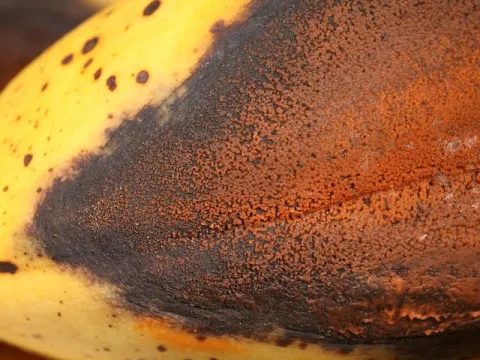
The initial signs of infection manifest as small, slightly depressed brown or black spots on the fruit peel. As the fungus colonizes the underlying tissues, these lesions expand and coalesce, eventually penetrating deep into the banana flesh.
A diagnostic sign of Colletotrichum musae is the formation of characteristic pink or salmon-colored spore masses within the center of the lesions. These fungal structures become highly visible under humid conditions or when examined with a magnifying lens.
Leaves display irregularly shaped necrotic spots that darken quickly. A yellow chlorotic halo often surrounds these lesions, indicating the plant's defensive reaction to the fungus and its secreted toxic metabolites, which accelerate the death of the leaf blade.
As the fruit ripens, the infected areas become heavily sunken. The underlying flesh softens and may exhibit a dark, discolored appearance with a distinct off-odor, making the fruit clearly unpalatable and unsuitable for consumption.
When the fruit stalk (pedicel) is infected, it develops necrosis, which can result in the premature snapping of the bunch. This weakening of the connection between the fruit and the main stem significantly complicates harvesting and post-harvest handling processes.
Control of Colletotrichum musae requires an integrated pest management approach. Regular sanitary pruning and the systematic removal of diseased plant parts are essential to reduce the inoculum pressure and limit the spread of the fungus within the plantation.
Prophylactic application of fungicides on developing inflorescences and bunches is a common practice to prevent primary infection. Growers must ensure that selected chemical treatments comply with international food safety regulations and designated pre-harvest intervals.
Post-harvest treatment is the most critical stage for commercial quality control. Washing fruit in specialized fungicidal solutions containing active ingredients like thiabendazole or prochloraz is effective in inhibiting latent fungal growth during long-distance transportation.
Maintaining an optimal cold chain at temperatures of +13-14°C during storage and transport is vital. This temperature range effectively suppresses fungal metabolism and keeps the latent infections in a dormant state, thereby preserving fruit quality until arrival at the market.
The use of disease-free planting material and the optimization of plantation layouts to improve airflow are fundamental strategies. These measures reduce humidity in the plant canopy and create conditions that are less conducive to the colonization and sporulation of the pathogen.