
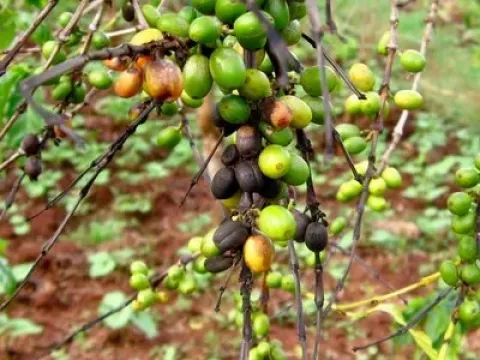
Colletotrichum kahawae
Colleotrichum kahawae
Colletotrichum kahawae is a specialized fungal pathogen responsible for Coffee Berry Disease (CBD). It belongs to the order Glomerellales and is a member of the Ascomycota phylum, causing significant devastation in coffee plantations worldwide.
What the section contains
Colletotrichum kahawae
The fungus specifically targets the genus Coffea, primarily Coffea arabica. Unlike other related Colletotrichum species, this pathogen is highly aggressive and adapted to thrive in high-altitude environments where premium coffee is grown.
Its systematic classification identifies it as a distinct species based on its host specificity and its unique ability to induce necrosis in developing coffee fruits. It is widely recognized as a serious economic threat to the global coffee industry.
In laboratory settings, identification is confirmed through morphological assessment of conidia and molecular techniques, such as PCR, which allow for rapid detection compared to traditional culturing on agar plates.
The fungus relies on a specialized lifecycle that enables it to survive during dry periods as mycelium within bark tissues or mummified berries, only to resume production of spores when humidity levels are suitable for infection.
The primary damage caused by this pathogen is the destruction of coffee berries at any stage of development. Infected berries suffer from necrosis, leading to rapid decay and a complete loss of commercial value.
Yield losses can reach up to 80% if environmental conditions are favorable for the fungus and no protective measures are implemented. This poses a major threat to the livelihoods of coffee farmers, particularly in African high-altitude regions.
Apart from berry destruction, the fungus can impact flower buds, leading to premature blossom drop. However, the most visible and economically damaging symptom remains the transformation of healthy green berries into blackened, shriveled "mummies."
The severity of the damage is often exacerbated by the vulnerability of popular commercial coffee varieties. Developing resistance is a priority for breeding programs, but until resistant cultivars are widespread, protection remains a constant struggle.
Constant monitoring of the fields is essential to detect outbreaks early. If left untreated, a single infected plant can become a massive source of spores for the entire plantation, causing localized epidemics.
The spread of Colletotrichum kahawae is directly driven by rainfall and humidity. Spores (conidia) are dispersed primarily by rain splashes that move the fungus from the canopy to the developing berries.
The ideal conditions for spore germination and infection include temperatures between 15°C and 25°C. These conditions are commonly found in the cool, moist climates where the highest quality Arabica coffee is produced.
Prolonged mist and high relative humidity are critical factors that trigger mass sporulation. In dry seasons, the fungus remains latent, waiting for the first signs of wet weather to continue its life cycle.
The rapid turnover of the life cycle means that a single infection cycle can last only a few days under optimal conditions. This allows the disease to propagate throughout a plantation in a very short time if the environment remains humid.
Aesthetic and structural management of the coffee trees is vital. Pruning helps to reduce humidity within the plant, which creates a less favorable environment for the germination of the spores during the rainy season.
Early symptoms appear as small, dark, water-soaked spots on the surface of green berries. These spots grow rapidly and eventually turn into dark brown or black sunken lesions.
As the infection progresses, the entire berry becomes blackened and hardens. In conditions of high humidity, these lesions become covered with a pinkish or orange mass, which consists of millions of microscopic fungal spores.
The infected berries often remain attached to the branches, drying out and turning into dark, shriveled mummified fruits. These mummies are extremely dangerous as they serve as the primary source of infection for the next season.
Flower infection is less frequent but occurs during periods of heavy rain, causing the flowers to brown and fall off prematurely. This further reduces the total potential crop yield before the fruit even begins to set.
- Water-soaked dark lesions on green berries.
- Presence of orange or pink spore masses during humid weather.
- Premature fruit drop and blackened berry clusters.
- Mummified, shriveled berries remaining on the tree branches.
The standard control method involves a strict schedule of fungicide applications. Copper-based fungicides are frequently used to protect berries during the critical stages of growth and high rainfall.
Sanitation is a crucial component of integrated management. Farmers are advised to remove and destroy infected berries and dead twigs to reduce the primary inoculum load within the plantation.
Breeding for resistance remains the most sustainable long-term solution. Many research initiatives are focused on identifying wild coffee species or resistant hybrids that can withstand infection without heavy pesticide reliance.
Proper canopy management, including regular pruning, is essential to ensure adequate airflow. A well-pruned tree dries out much faster after rainfall, which significantly limits the time the fungus has to initiate infection.
Integrated Pest Management (IPM) strategies combine cultural, chemical, and biological measures. This holistic approach helps farmers secure their yields while minimizing the environmental impact of intensive agricultural practices.