Autumn variety selected at the Central Siberian Botanical Garden (CSBG) of the Siberian Branch of the Russian Academy of Sciences. Breeders: V. N. Vasil'eva, N. V. Moiseeva. Obtained by crossing Belfler-China with a fruiting apple (Siberian). It has been approved for use in the Novosibirsk region and has gained wide recognition there. It is also widely cultivated in many regions of Eastern and Western Siberia, the Urals, and Northern Kazakhstan. It is popular among amateur gardeners.
Medium-sized tree; when fully fruiting, the tree takes on a rounded, drooping shape, so the trunk should be 30-40 cm. Compact crown, fruiting in clusters.
Shoots are brown, slightly curved, densely hairy. Leaves are medium-sized, elongated-oval, slightly pointed, green with a bluish tint, matte, with large rounded margins. Petioles are of medium length, hairy, with lanceolate stipules.
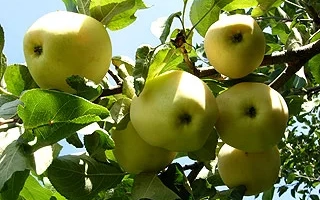
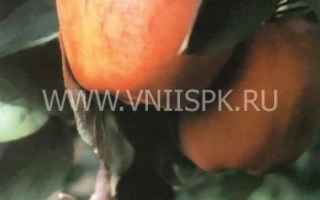
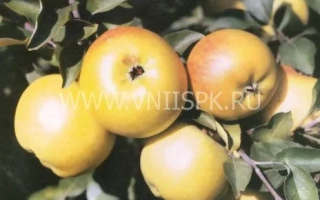
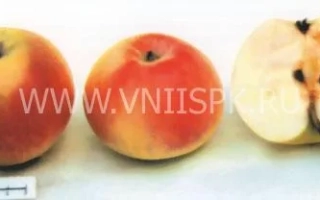
Fruits are roundish, medium-sized (up to 40 g). Main color is light yellow, with a reddish blush covering most of the fruit. Peduncle is medium-length, straight. Calyx does not drop off, half-open with a short pouch-like calyx tube. Seed chambers are half-open, containing brown, conical seeds.
Flesh is creamy, medium density, fine-grained, tender, juicy, slightly aromatic, with a pleasant flavor. Chemical composition of the fruit: total sugars — 10.6% (8.4–13.6%), titratable acids — 1.3% (0.9–1.56%) on fresh weight, tannins — 0.11%, ascorbic acid — 29 mg/100g (19.0–45.5 mg/100g), polyphenols (catechins) — 260 mg/100g (105–457 mg/100g), pectin substances — 1.1% (0.55–2.1%) on fresh weight.
Fruits ripen at the beginning of September and can be stored until the end of October.
Fruits are consumed fresh and are highly processable (juices, compotes, jams, etc.). During processing, the fruits exhibit good gelling properties, with pectin and polyphenols well preserved. For making compotes and marinades, fruits are used whole with the peduncle.
Begins fruiting at age 3. The variety is low-maintenance, with regular yields — up to 92 kg per tree. It is cold-hardy and resistant to fungal diseases.
Advantages of the variety: high ecological resilience, regular yields, resistance to scab, high commercial and consumer qualities of the fruit.
Disadvantages of the variety: more demanding in cultivation technology; productivity decreases in dense plantings.
The variety Palmetta is a valuable genetic resource for breeding for cold hardiness, yield, early fruiting, high vitamin content, and excellent processing qualities. At CSBG, the variety Palmetta has been used in numerous hybrid combinations, including with the best selected forms of wild apple Sivera. Winter-hardy, low-growing forms have been selected from the hybrid background.