An old English variety, ripening in autumn in southern regions of Russia, and in more northern areas — in winter. This variety was obtained by Dilemma in 1800 in England. It became popular not only in England but also began to spread across Europe. In the last decade, it has become less popular due to uneven fruit size, damage by fruit borers and diseases, and fruit drop before ripening.
Trees of medium or large size, pyramidal when young, spreading and broad when fruiting. Branches emerge from the trunk at a right angle and extend upward.
Shoots are thick, curved, dark green with a brownish tint, heavily hairy, with few small stipules. In nurseries, shoots are gray-brown. Leaves are elongated or broadly oval with a rounded base and clearly defined tip, smooth, with doubly serrated edges; they form an acute angle with the stem. The upper leaf surface is dark green, the underside is matte. Petioles are thick, stipules are narrow and lanceolate.
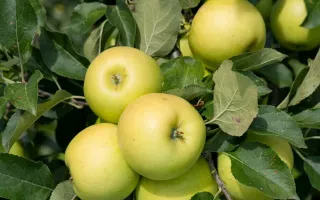
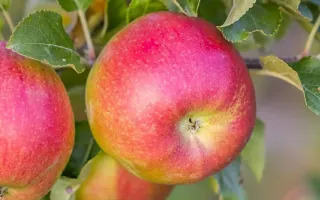
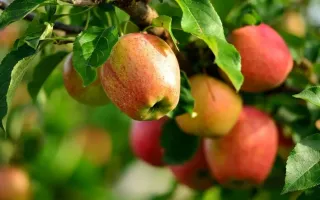
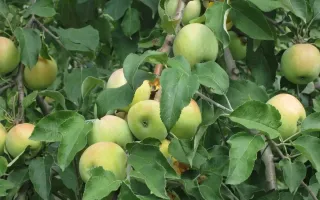
Fruits are medium to large, rounded-conical with a broad base, without ribs. Skin is thin but firm, covered with a strong waxy layer upon ripening. Primary color at harvest is light green with orange-red blush and more intensely colored streaks and spots. During storage, fruits turn yellow and acquire golden-orange tones. Peduncles are thin and short.
Flesh is light yellow, cream-colored during storage, tart-sweet, very firm, juicy, and fragrant.
On Kuban, fruits ripen in mid-August; in more northern latitudes — later. Fruits are stored until November or December. Under poor storage conditions, they develop bitter rot. Under low humidity and high temperatures, fruits drop prematurely at the beginning of harvest maturity. This is a rapid-fruiting and high-yielding variety.
Trees are moderately winter-hardy and weakly drought-tolerant.
Advantages of the variety: fruits have high consumer quality.
Disadvantages of the variety: uneven ripening, susceptibility to scab.
In breeding — donor of flesh density and fruit aroma.








Reviews · 1