


SKU #3472
·
381 views
Altai Pepin
Apple
User rating
0 votes0% positive reviews
No ratings yet — be the first.
Type of Sort
Autumn Apple Variety
About product

This autumn variety was obtained at the Scientific Research Institute of Horticulture of Siberia named after M. A. Lisavensky by crossing 'Purple Early' with 'Saffron Pepin' in 1937. Breeders: M. A. Lisavensky, I. A. Kukharsky, M. A. Sizemova, V. A. Sirotkina. Widely grown in commercial plantations and gardens of the population in Western and Eastern Siberia. Approved since 1959 for the West Sibe…
Type of Sort
Autumn Apple Variety
Description
This autumn variety was obtained at the Scientific Research Institute of Horticulture of Siberia named after M. A. Lisavensky by crossing 'Purple Early' with 'Saffron Pepin' in 1937. Breeders: M. A. Lisavensky, I. A. Kukharsky, M. A. Sizemova, V. A. Sirotkina. Widely grown in commercial plantations and gardens of the population in Western and Eastern Siberia. Approved since 1959 for the West Siberian region.
Trees are low-growing, with round crowns and medium density. Fruit-bearing is concentrated, primarily on spurs and fruiting shoots, on 1-3-year-old growths.
Shoots are gray-green, hairy, with small light pubescence. Leaves are medium-sized, round, with a small tip, dark green, shiny, slightly puckered, slightly hairy underneath, with doubly serrated edges, long petioles, hairy, with small stipules.
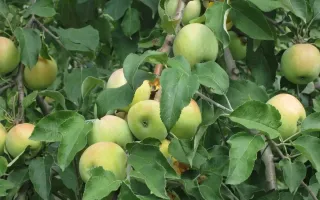
Fruits are very small (30-51 g), round-conical, ribbed. Main color is yellow, covering color is bright red, solid. Peduncle is medium length, calyx is narrow and deep, rusted. Calyx is small, half-open, surrounded by pearls. Receptacle is small, ribbed.
Flesh is yellow, firm, juicy, slightly acidic-sweet, medium taste. Chemical composition of fruits: total sugars — 12.7% (7.2-15.9), titratable acids — 1.75% (0.84-2.38), tannins — 217 mg/100g (73-373), ascorbic acid — 29.9 mg/100g (6.6-61.5), P-active compounds — 514 mg/100g (104-754), pectin substances — 5.84% on dry weight.
Harvest maturity in the second decade of September, storage life up to 30 days. This is a technical variety, widely used in winemaking.
Begins fruiting in the third to fourth year. High, regular yield. High winter hardiness; in particularly severe winters, it suffers slight frost damage. Lost resistance to scab and became sensitive to it.
Advantages of the variety: high winter hardiness and yield.
Disadvantages of the variety: very small fruits of medium taste, sensitive to scab.
Crop & resistance
Crop
Specifications
| Type of Sort | |
|---|---|
| Catalog | Catalog → Apple |
Store offers
Prices are updated on loadLoading offers…
Aggregator catalog: prices are collected automatically from store websites, normalized by AI and converted at the current exchange rate. Before ordering, confirm the price and availability on the store's website. This block is not indexed by search engines — the data is loaded after the page opens.
Not yet комментариев. Be the first!
Alternatives
Apple saplings · similar varieties


See also
Often considered together with this variety




Recently viewed
Products you’ve viewed on this site
Reviews · 0