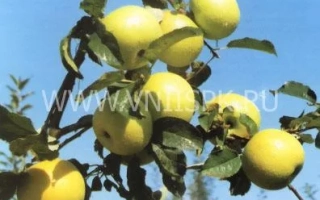
An old, widely known Russian variety of folk selection with early fruit ripening. First described in 1797 by the famous Russian pomologist A. T. Bolotov.
The variety was excluded from the State Register for the Central Chernozem region due to its shortcomings, but it remains registered for the Northern, North-Western, Central, Volga-Vyatka, Middle Volga, Ural, West Siberian, and East Siberian regions.
Trees are of moderate size, densely branched. The crown is strong, broad-pyramidal in young trees, gradually becoming spherical with age. The bark of main branches is orange-yellow in color.
Fruits are located on numerous rings.
Shoots of medium thickness, reddish-brown, moderately hairy. In the nursery, Moscow Pear produces one-year shoots of moderate height, and two-year shoots with well-formed crowns. Bark of shoots in the nursery is shiny, smooth, dark-purple. Leaves are large, elongated, with a yellowish tint, not curled or nearly not curled, finely reticulate, weakly hairy or hairless. Often, leaves are reverse-folded (sickle-shaped). Petioles are large.
Flowers are large, dish-shaped, buds are pink, petals are light pink, elongated or elongated, stigma level with or slightly below stamens.
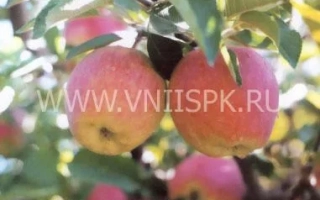
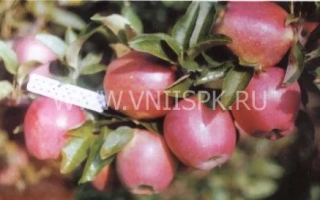
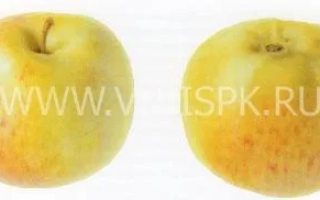
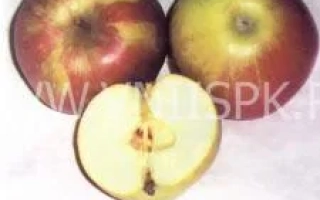
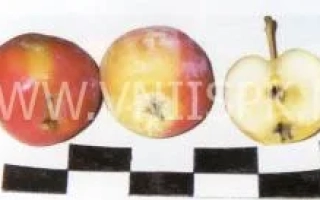
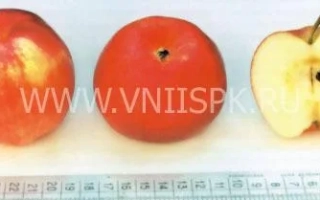
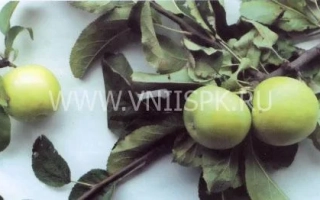
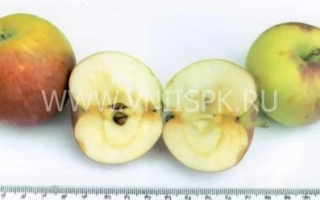
Fruits (see photo) ripen early, are small to medium-sized, strongly flattened (almost onion-like), slightly ribbed. Skin is smooth. Main color is yellow-green, whitening upon ripening. Covering color is a light, blurred blush and pink stripes and spots. Subcutaneous points are numerous, whitish. Peduncle is short, medium or thick. Venter is deep, wide, without rust. Dish is small, wide. At the base of the sepals, usually, prominent swellings ("pearls") are visible. Calyx is closed. Heart is onion-like. Seed chambers are closed. Seeds are of medium size, light chestnut color.
Fruit flesh is white with a yellowish tint, sometimes pink beneath the skin, loose, juicy, tender, aromatic, tart-sweet in flavor, often with a predominance of acidity. Chemical composition of fruits: total sugar — 9.2%, titratable acids — 0.89%, ascorbic acid — 9.3 mg/100g, P-active substances — 129 mg/100g.
Harvesting period for fruits in the Priokskaya horticultural zone usually occurs in the first decade of August. Consumer period lasts 2-3 weeks. Due to uneven ripening on the tree, fruits often drop off.
Fruits are not suitable for long-distance transport. Main use is fresh consumption; may be used for juice preparation.
During fruiting, trees ripen early, produce abundant but irregular yields. The variety is highly winter-hardy and surpasses common Antonovka, Borovinka, and Autumn Striped in this trait. The variety is weakly resistant to scab.
Advantages of the variety: high winter hardiness and yield, early fruit ripening.
Disadvantages of the variety: small, low-quality fruits, uneven ripening. Weak resistance to scab.
Only a few new varieties have been developed using Moscow Pear, including "Siberian Souvenir" (Moscow Pear x garden form of Siberian berry apple) at the Central Siberian Botanical Garden.