


SKU #59837
·
38 views
Pyramid
Wheat
User rating
0 votes0% positive reviews
No ratings yet — be the first.
Type of Development
Spring wheat
Wheat Type
Soft wheat variety
Growing Season
80-90 days
Seed: mass 1.000 pcs seeds
35-40 grams
Prices in stores
from12.89 €per 1 kg
pack from 64.44 € per 5 l
2 offers from 2 stores
Store offers · 2 from 2 stores
Prices are updated on loadLoading offers…
Available at: Agropomich · Агрохім
Aggregator catalog: prices are collected automatically from store websites, normalized by AI and converted at the current exchange rate. Before ordering, confirm the price and availability on the store's website. This block is not indexed by search engines — the data is loaded after the page opens.
About product

The 'Pyramid' wheat variety is a medium-maturing type of soft spring wheat (Eritrospermum) developed at the Penza NIIAS with the participation of the Samara NIIAS. This variety is characterized by vitreous, large grains weighing 34-36 g per 1000 grains, with an egg-shaped shape and a long awn. The vegetative period lasts 74-81 days; the 'Pyramid' variety matures 3-4 days earlier than the Prokhorov…
Type of Development
Spring wheat
Wheat Type
Soft wheat variety
Growing Season
80-90 days
Seed: mass 1.000 pcs seeds
35-40 grams
Description
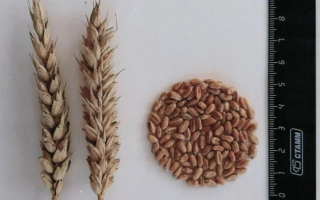
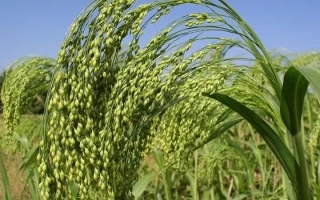
The 'Pyramid' wheat variety is a medium-maturing type of soft spring wheat (Eritrospermum) developed at the Penza NIIAS with the participation of the Samara NIIAS. This variety is characterized by vitreous, large grains weighing 34-36 g per 1000 grains, with an egg-shaped shape and a long awn. The vegetative period lasts 74-81 days; the 'Pyramid' variety matures 3-4 days earlier than the Prokhorovka and L-503 varieties. The plant is semi-erect, the stem is of medium thickness with a strong waxy coating on the upper internode, and the ear is cylindrical of medium density and white color. The ear arm is straight, the lemma is of medium length, and is also straight.
The variety has high resistance to lodging, which ensures crop preservation and reduces losses during harvesting. 'Pyramid' is not affected by loose smut or brown rust; moreover, if left on the stalk, the grain does not shed or germinate. Drought resistance is assessed as below average, but it demonstrates good resistance to root rots and medium susceptibility to powdery mildew. The average yield in the region is about 3.0-3.5 tons per hectare, which corresponds to 18.2 centners per hectare. The grain exceeds the standard by 2-3% in protein and gluten content, making it suitable for producing high-quality flour and improved baking properties.
'Pyramid' is a valuable wheat for cultivation in the Middle Volga region due to a combination of high yield, disease resistance, and good grain technological characteristics. The variety is recommended for use in the baking industry, where its quality indicators are valued. Due to resistance to lodging and diseases, as well as high grain retention when left on the stalk, 'Pyramid' ensures a stable and high-quality yield.
The variety has high resistance to lodging, which ensures crop preservation and reduces losses during harvesting. 'Pyramid' is not affected by loose smut or brown rust; moreover, if left on the stalk, the grain does not shed or germinate. Drought resistance is assessed as below average, but it demonstrates good resistance to root rots and medium susceptibility to powdery mildew. The average yield in the region is about 3.0-3.5 tons per hectare, which corresponds to 18.2 centners per hectare. The grain exceeds the standard by 2-3% in protein and gluten content, making it suitable for producing high-quality flour and improved baking properties.
'Pyramid' is a valuable wheat for cultivation in the Middle Volga region due to a combination of high yield, disease resistance, and good grain technological characteristics. The variety is recommended for use in the baking industry, where its quality indicators are valued. Due to resistance to lodging and diseases, as well as high grain retention when left on the stalk, 'Pyramid' ensures a stable and high-quality yield.
Crop & resistance
Crop
Disease resistance
Specifications hover over for a hint about the specification
| Type of Development | |
|---|---|
|
Wheat Type
Wheat Type
Biologically hard wheat differs from soft wheat in its greater demand for soil fertility and agronomic conditions (especially regarding field cleanliness from weeds), lower drought resistance and plasticity, relatively weaker root development, especially nodal roots, and lower ti... |
|
| Growing Season | 80-90 days |
| Seed: mass 1.000 pcs seeds | 35-40 grams |
| Resistance to lodging | |
| Potential Yield | 4-5 tons |
| Registration year | 2000 |
| Catalog | Catalog → Wheat |
| Legal data |
Show · 17
|
| Country | Russia |
Not yet комментариев. Be the first!
Alternatives
Wheat seeds · similar varieties






See also
Often considered together with this variety



CANDLES
ФГБНУ Федеральный Аграрный Научный Центр Северо-востока имени Н.В. Рудницкого
032 1 offer
4.24 € ≈ 218 ₴





Recently viewed
Products you’ve viewed on this site
Reviews · 0