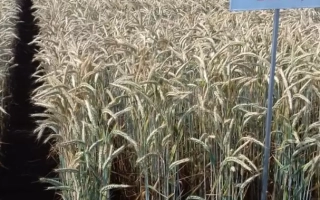
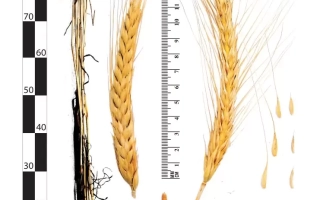
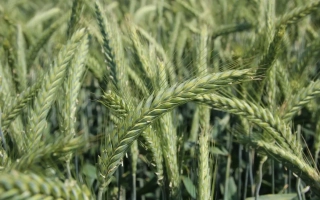
GOLDBARG is a winter triticale (X Triticosecale Wittm. ex A. Camus) variety intended for grain use for both food and fodder purposes. It is characterized by an early or medium heading time and belongs to the group of early-maturing varieties. The plant is tall with a semi-prostrate bush, white long and dense spike, fully awned. The grain is semi-elongated, naked and yellow. The 1000-grain mass varies from 40.9 to 47 grams, indicating high seed quality.
The variety is distinguished by high drought resistance exceeding the average level, making it suitable for cultivation in various climatic conditions. GOLDBARG is resistant to brown and stem rust, and possesses moderate resistance to snow mold. Protein content in the grain reaches 16.9%, which is an important indicator for food use. The maximum grain yield recorded in the Stavropol region was 106.9 c/ha, with an average yield of about 30.1 c/ha in some regions.
The variety is recommended for cultivation in a wide range of regions, including the Central, Volga-Vyatsky, Central-Black Earth, North Caucasus, and Lower Volga regions. It is suitable for sowing in Bryansk, Vladimir, Ryazan, Smolensk, Tul, Kirov, Sverdlovsk, Lipetsk, Rostov regions, Krasnodar and Stavropol krais, as well as in the Republics of Adygea and Kalmykia. GOLDBARG seeds meet quality standards and are widely used in agronomic practice to obtain high grain yields.